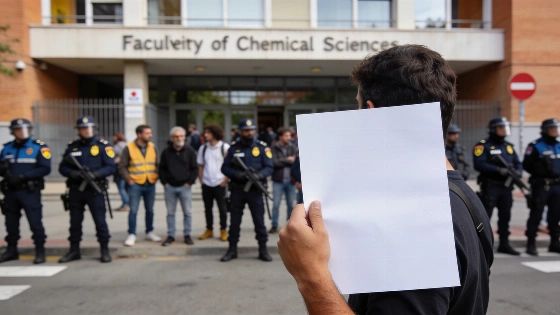
Madrid’s teachers began an open-ended strike on 14 October. Unions reported 70% participation, against 44.6% from the regional government; five people were detained after police charged a picket.
At the Complutense University of Madrid, police charged a picket on the first day of the region’s teachers’ strike. The indefinite walkout began on 14 October after a campaign agreed in June. Unions said six people were injured, including one with a head wound, and that some were taken to hospital. Police reported five arrests and said an officer was also injured.
The strike covers 65,000 teachers in non-university public education, whose schools teach more than 666,000 pupils. It includes infant and primary schools. Secondary schools and vocational training are covered too. Comisiones Obreras, or CC OO, put participation at 70%. Madrid’s education councillor, Mercedes Zarzalejo, said 44.6% of staff took part.
The gap between those figures is stark. CCOO and UGT joined the indefinite action. CGT and CNT also took part. STEM and Solidaridad Obrera joined them, alongside education platforms including Educación Especial Digna and Menos Lectivas. Queremos FP also joined the campaign.
Teachers and school directors who spoke to EL PAÍS described turnout as higher than in previous strikes, particularly in southern Madrid and the capital. Some schools reported near-total participation once minimum-service staff were excluded.
In Alcorcón, teacher Charo Fernández said staff assigned to minimum services had to supervise several classes at once. The regional government said those services would be maintained during the strike to protect students’ access to education. They would also allow non-striking staff to work.
The dispute centres on staffing and workload. Pay is also at issue. Unions want weekly classroom hours cut from 19 to 17 in secondary schools and vocational training. For infant and primary education, they want the limit reduced from 25 to 22.
They are seeking class-size limits of 13 pupils in infant education and 15 in primary. Their proposed caps are 20 in secondary education and 23 in vocational training. Unions also want more funding and higher salaries. They are calling for more specialists to support pupils with additional needs, action against socioeconomic segregation between public and publicly funded private schools, and a €600 monthly pay rise. Their demands also include less paperwork and improved school buildings.
Teachers described the strain inside classrooms. Natalia Cabello, a teacher at the Loyola de Palacio school in Villa de Vallecas, said pupils had sat exams wearing gloves because classrooms were too cold. She also cited excessive heat as a problem. Unions link their demands to staff shortages and crowded classes. They say pupils with additional educational needs lack sufficient support.
At the Complutense campus, a picket outside the Faculty of Chemical Sciences met a police cordon. A CGT delegate said officers blocked the group before charging. A police spokesperson said the charge came after an attempt to cross the cordon. The Government Delegation defended the right to demonstrate and said any confirmed police excess would have consequences.
Thousands of demonstrators gathered at Puerta del Sol. About 5,000 people then headed towards the Education Department. Protesters blamed regional president Isabel Díaz Ayuso and Madrid mayor José Luis Martínez-Almeida for what they called the weakening of public education.
Educators and students joined the rally. Unions took part as well. Workers from infant schools also blocked Paseo de la Castellana. Student and family organisations have joined the campaign. Its organisers have linked the defence of public education to the regional government’s policies.
Zarzalejo said her department was willing to hear teachers’ demands. She accused the organisers of pursuing political and electoral objectives, called the union proposals impossible and said the strike was unjustified while negotiations continued. As of 14 October, talks remained open, but no agreement had been reached. Education Minister Milagros Tolón urged regional governments to negotiate, saying lower class sizes and fewer teaching hours were important to education quality.
The main union bloc has called an indefinite strike, with no end date set. Separately, CSIF announced a three-day strike from 14 to 16 October. The action began six weeks before the early regional elections scheduled for 29 November 2026.