Construction crews in Madrid have finished excavating a tunnel beneath the Paseo de la Castellana, a major step toward opening Parque Castellana. The 675-meter-long redevelopment, approximately 90 meters wide, will create about 70,000 square meters of public space above the buried avenue. It will reclaim road-dominated surface land for parkland, with better pedestrian areas and urban connections. The site lies between Calle de Sinesio Delgado and the Nudo Norte interchange on the M-30, opposite the city’s principal high-rise complex.
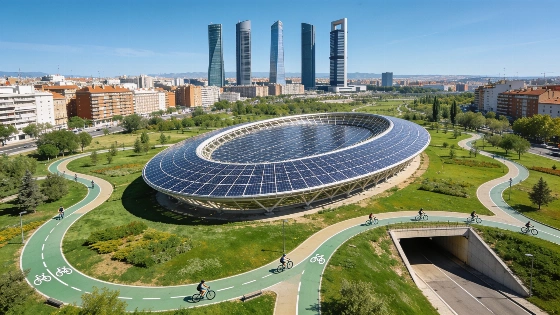
The project’s basic feature is a 35-meter-high elliptical pergola at the park’s northern edge. Its structural frame was complete by October 20, 2026, but installation of the photovoltaic panels was still pending. The finished structure is expected to weigh 33 metric tons and hold up to 2,500 square meters of panels, with a peak installed capacity of 340 kW. Cables visible along its upper section are part of preparations for the solar array. The pergola is designed to anchor the northern Castellana axis and generate electricity.
Transforming Mobility
The tunnel, running from Calle de Sinesio Delgado to the Nudo Norte interchange on the M-30, will divert through-traffic underground, leaving the surface for local vehicles and public transport. It will have three lanes in each direction and dedicated access points, and is scheduled to open to traffic in December 2026. Above ground, the reclaimed space will serve pedestrians and cyclists, with green areas alongside them. The changes will reshape how people use one of Madrid’s busiest corridors.
Plans also include a second underground level, scheduled for excavation this summer, to allow future connections to the Begoña neighborhood and the Madrid Nuevo Norte business district. The design will link the park with upcoming urban development while preserving flexibility for future connections.
Green Spaces and Community Life
Parque Castellana is set to become a green axis connecting the area of the five towers with Hospital Universitario La Paz, the historic San Cristóbal neighborhood and the future Madrid Nuevo Norte hub. The landscaping plan includes 772 new trees, bringing the total to more than 1,000, alongside more than 38,800 shrubs. A pine grove will feature cypresses, cedars and holm oaks, with recreational amenities throughout.
Residents and visitors will find shaded seating areas and children’s playgrounds, along with calisthenics equipment, a health circuit and a segregated two-way bike lane on the eastern edge. At the park’s southern end, a landscaped hill will sit near stone benches and an open-air amphitheater. The area will also have a large fountain and a central plaza shaded by a second, smaller pergola measuring 25 meters in diameter.
Energy and Urban New idea
A dedicated pavilion beneath the basic solar canopy will house equipment to convert and manage the electricity generated, with the capacity to send excess power to the city’s grid. The park’s sole crossing will be reserved for public transport and local traffic. That arrangement maintains mobility while giving priority to green and communal spaces.
The €110.2 million investment pairs infrastructure upgrades with environmental improvements. It also forms part of Madrid’s wider green and blue infrastructure strategy. The city’s 2026 Green Guide, presented on October 19 by Borja Carabante, Madrid’s delegate for Urbanism, Environment and Mobility, lists 36 spaces: six new or emerging municipal projects and 30 existing parks and green areas. Parque Castellana is one of the six initiatives, alongside the Paseo Verde del Suroeste and Madrid Nuevo Norte, with Parque de Ventas also included.
The park is part of a broader effort to connect green spaces across northern Madrid. CreaMNN, the Madrid Nuevo Norte development entity, describes the area’s environmental corridor as more than three kilometers long, extending the historic Prado-Recoletos-Castellana axis northward. Planned links from Parque Castellana to Begoña will continue to Madrid Nuevo Norte, extending the project’s reach beyond the immediate roadworks.
Madrid’s large-scale urban renewal echoes the entrepreneurial spirit found in other sectors, including fitness, where investment has reshaped city life. One example is Vitalfit’s expansion in Palma de Mallorca, detailed in this report on building a multi-million euro gym chain.
With tunnel work in its final phase and the pergola’s frame complete, Parque Castellana is approaching its next milestones: the tunnel’s expected reopening in December 2026, installation of the solar panels and completion of the surface park. The transport works and new public space, together with the planned renewable-energy system, are intended to reshape Madrid’s northern entrance.