Madrid faces a standoff over a planned waste depot in Montecarmelo. Residents protest its proximity to schools and homes. The city’s handling of similar sites elsewhere exposes inconsistencies in urban planning.
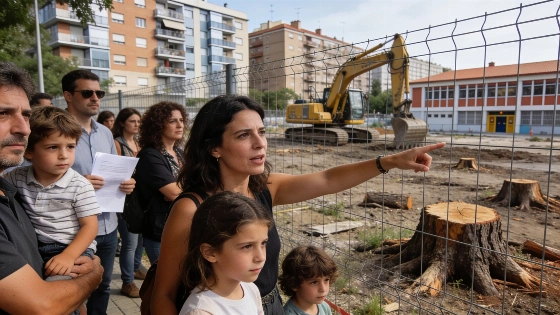
Madrid’s plan to build a waste depot in Montecarmelo has run into strong resistance. Residents have stopped tree cutting at the site and won a court order to suspend construction. Their main objection isn’t the depot itself, but its location—right across from the Sol Solito nursery, the Colegio Alemán, and close to Santa María La Blanca school. For three years, neighbors have filed complaints, pored over blueprints, and taken their case to the streets and the courts, arguing that safer locations exist and the city is ignoring them. Official bulletins from the Comunidad de Madrid make no direct mention of the Montecarmelo project, leaving the dispute without clear documentation in public records.
Just 20 kilometers away in Vicálvaro, a nearly identical waste depot operates without issue. The difference is location: Vicálvaro’s depot sits in an industrial area, surrounded by workshops and warehouses, far from homes or schools. Even the local neighborhood association president calls its placement logical and says it causes no problems. Still, the Comunidad de Madrid’s environmental portal currently lists no specific information about the Montecarmelo dispute or its regulatory status.
В официальных бюллетенях Comunidad de Madrid (BOCM) отсутствуют сведения о проекте мусорного депо в Montecarmelo, несмотря на общественный резонанс вокруг темы.
Both depots follow the same design: a three-story main building, workshops, storage, vehicle washing, and facilities for gas, electric charging, and waste compaction. The real difference is context—one is isolated among factories, the other squeezed into a residential neighborhood. Montecarmelo’s own environmental report admits the depot will bring noise from trucks and machinery, a bigger concern given how close it is to schools and homes. Madrid’s rules for environmental impact assessments require detailed documentation and public disclosure for such projects, but no such documents have turned up for Montecarmelo so far.
Residents have suggested more than 30 alternative sites, favoring the ED-1 plot in Las Tablas, which even has support from that neighborhood’s association. The proposal reached city council and was backed by Más Madrid, PSOE, and Vox, but the PP majority blocked it. City planning documents show that in other districts, similar sites were rejected for being too close to homes, with industrial parcels chosen instead to reduce impact. Yet there is no confirmation from the Ayuntamiento de Madrid or other official sources about whether these alternatives were seriously considered for Montecarmelo.
The legal fight escalated in 2025 when a Madrid court ordered construction to stop, the second time the project has been halted by a judge. Earlier, another court sided with the Colegio Alemán and ruled that a full environmental assessment was needed. Despite public statements from the district’s councilor that the depot would be scaled back to just offices and parking, official project documents still list workshops, a gas station, waste compactors, and a transfer plant. The city’s legal team has dismissed the councilor’s comments as irrelevant to the administrative process.
По данным официального портала Comunidad de Madrid по вопросам отходов и окружающей среды, в открытом доступе отсутствуют конкретные нормативные или проектные документы, касающиеся спора о депо в Montecarmelo. Для полноценной проверки деталей дела необходимы отдельные первоисточники, такие как судебные решения или публикации Ayuntamiento de Madrid.
For Montecarmelo’s residents, the city’s selective approach to planning is hard to ignore. In other neighborhoods, officials have cited the need to keep such facilities away from homes, but in Montecarmelo, they are pushing ahead despite the risks to daily life. The situation echoes frustrations seen elsewhere in Spain when city policies clash with local needs, as described in a recent report on rural anger over city-driven decisions.
Madrid’s handling of waste infrastructure shows a double standard: what’s ruled out near homes in one district is forced through in another. The city’s refusal to consider alternative proposals, even those backed by several political groups and local associations, points to a top-down planning style that puts administrative convenience ahead of residents’ well-being. Until the courts make a final decision, Montecarmelo’s future is caught between legal appeals and the city’s determination to move forward, despite growing local opposition.