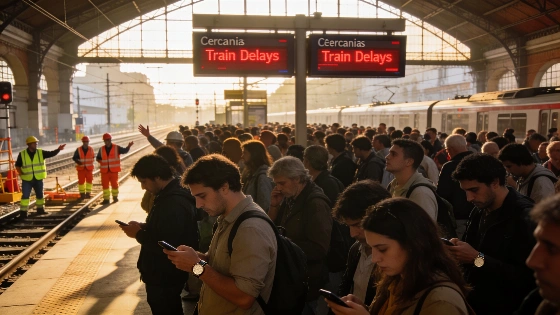
Madrid's Cercanías network faced severe delays after a power outage during key works at Atocha. Passengers saw route changes and packed platforms. Some lines remain affected as services recover.
Madrid's Cercanías rail network was thrown into disarray early Friday after a power supply failure at Atocha station coincided with the start of a critical phase of track works. The outage, which began before dawn, led to widespread delays, train stoppages, and sudden changes to regular routes, according to official updates from Cercanías at 6:32 a.m. The disruption was directly linked to ongoing construction at Atocha, where a new track layout is being installed to boost the Sol tunnel's capacity by a third.
By mid-morning, most lines were gradually returning to normal, but the C-3 and C-4 routes continued to experience significant delays and altered services. Adif, the public rail infrastructure company, confirmed via its X account that the power supply issue was being addressed as quickly as possible, but warned that delays would persist until full resolution. The company also reported that efforts were underway to restore normal operations across the affected network.
Compounding the morning's problems, a separate technical fault around 8 a.m. forced a suspension of service between Colmenar and Tres Cantos on the C4b line. This incident, traced to a malfunction in the traffic regulation systems at Colmenar Viejo, was resolved within hours, allowing trains to resume with gradually improving frequencies. Throughout the morning, social media was flooded with images and videos showing crowded platforms and long queues for escalators, highlighting the scale of the disruption for commuters.
This week has seen repeated issues at Atocha, with a similar breakdown on Wednesday causing delays, stoppages, and route changes. The latest incidents coincide with the launch of a new phase of works at Atocha Cercanías, which will continue to affect services until July 22. During this period, the C-3 line (Aranjuez-Chamartín) will start and end at Villaverde Bajo, requiring passengers to transfer to C-4 trains for onward travel to Atocha and Chamartín. The C-4a route (Parla-Alcobendas/San Sebastián de los Reyes) is suspended between Atocha and Parla, with trains operating only between Atocha and Alcobendas/San Sebastián de los Reyes. Travelers heading to Parla must switch to C-4b trains, which are running as normal. The C-5 line (Humanes-Móstoles El Soto) will also start and end at Atocha, with passengers needing to transfer at Atocha for journeys toward Humanes, Fuenlabrada, or Móstoles-El Soto.
Further changes are planned: from July 23 to August 16, only the C-5 will be affected, with a complete closure between Villaverde Alto and Embajadores. During this time, trains between Humanes/Fuenlabrada and Villaverde Alto, as well as Móstoles El Soto and Embajadores, will run every 10 minutes. Shuttle trains will connect Villaverde Alto and Méndez Álvaro, stopping at Puente Alcocer, Orcasitas, and Doce de Octubre, with a 35-minute frequency. Additional works from August 1 to 28 will impact lines C-2, C-7, C-8a, C-8b, and C-10, though only frequencies will be affected.
These disruptions come as Madrid's transport system faces broader challenges and regional tensions. For example, recent disputes over public transport card funding between Madrid and other regions, such as Catalonia and Galicia, have highlighted the complexity of coordinating mobility policies across Spain. A related report on regional funding disagreements can be found in this analysis of Madrid's transport card funding standoff with Catalonia.
Madrid's Cercanías network is one of the busiest in Spain, serving hundreds of thousands of daily commuters. Atocha station is a central hub, and any disruption there quickly ripples across the city and surrounding areas. The current works are part of a long-term plan to modernize infrastructure and increase capacity, but the immediate impact has been a series of delays and forced changes for passengers. Authorities continue to urge travelers to check updates and plan for possible disruptions as the works progress through the summer.