Teatro Real opened its 2026-27 season with Puccini's Manon Lescaut on 23 September 2026. Nicola Luisotti led a strong orchestra, but the cast and predictable staging never fully caught fire.
Teatro Real opened its 2026-27 season with a Manon Lescaut that is polished enough to satisfy, yet too familiar to surprise. The first performance took place on 23 September 2026. Thirteen performances are scheduled through 11 October.
The production brings together Sondra Radvanovsky, Michael Fabiano and Lucas Meachem under Nicola Luisotti. This is Luisotti's third Teatro Real season opening. The cast also alternates with Saioa Hernández, Jorge de León and Szymon Mechliński. The evening's main problem is the gap between the artists' reputations and the limited impact of the performance as a whole.
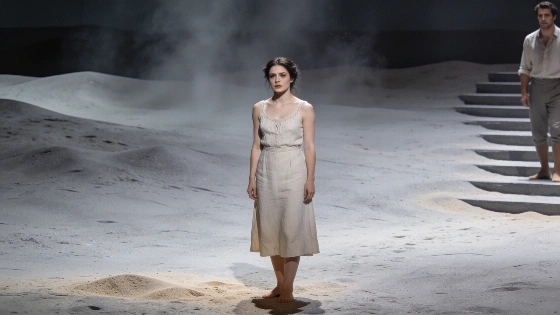
Carlos Wagner's staging works without becoming memorable. It is new to Madrid and was created in co-production with Oper Köln. Its broad empty spaces and grey palette move cleanly from Paris to the port of Le Havre and later to the Louisiana desert.
The crowd scenes are especially well handled during the ball in Amiens and the counting of the condemned women. The final procession gives shape to a scene with little action. It also creates a genuinely mournful close.
Manon Lescaut returned to the Teatro Real stage after an absence of 102 years.
Even so, the production looks as if it has already been seen. That feeling of déjà vu is striking because the Madrid staging is new. Wagner changes the visual frame without finding a clear theatrical idea of its own.
The costumes sit between the 20th and 21st centuries. The symbolic spaces stay open and interchangeable. This visual language could belong to Tosca, Lucia or even La fille du régiment as easily as to Puccini's Manon Lescaut.
For readers following Madrid's wider cultural and sporting agenda, the contrast with the Madrid derby preview is revealing. The opera does not lack established names. It lacks a sharper angle of its own.
Radvanovsky has the power and range the role demands. Her vibrato worked especially well in the tragic fourth act, where she dominated the stage. Earlier in the evening, her heavy oscillation and affected delivery worked against Manon's innocence and youth. The voice sounded imposing rather than fresh. The phrasing rarely felt spontaneous.
The Teatro Real scheduled 13 performances of Manon Lescaut from 23 September to 11 October 2026. The opening was also attended by King Felipe VI, according to the official Casa Real record.
Michael Fabiano also fell short of his best form as Des Grieux. His musicality was clear, as was his close work with the orchestra. Some of Puccini's high notes proved difficult. His metallic American timbre did not carry its usual force.
Meachem had more trouble in Lescaut's low register. His projection there lacked firmness.
The supporting cast handled its assignments well. Mercedes Gancedo provided the most tender vocal moment in the second-act madrigal scene. Her sweet, innocent sound blended attractively with the women of the Teatro Real chorus.
The chorus also acted strongly and sang with confidence. The announced line-up alternates between two casts. The second group includes Saioa Hernández, Jorge de León and Szymon Mechliński alongside the performers heard in this account.
The 2026-27 season includes 16 titles and six new co-productions, according to season coverage. Manon Lescaut fits that larger program of international projects and new productions, even if Wagner's staging feels visually familiar.
From the pit, Luisotti supplied the performance's firmest foundation. He kept the orchestra from covering the singers or chorus. He also brought out the recurring motifs that recall Wagnerian Leitmotive.
The flutes, led by Aniela Frey, stood out alongside the harp and percussion. The brass were excellent in the third act, although the Intermezzo contained some early entries. Among the strings, Simon Veis made a notable contribution with his cello solo.
Europa Press identified Luisotti's musical leadership as one of the main features of the season opening. That judgment matches what was heard in the theatre.
The result is clear. Luisotti gives the Madrid ensemble a dependable musical engine. Wagner offers a stage picture that functions, yet rarely challenges the audience.
The cast has talent and experience. The central roles do not always match the characters' dramatic age or vocal demands. The story comes from Abbé Prévost's 1731 novel. Three operatic versions had already appeared before Puccini's, which makes the lack of a fresh interpretive idea more noticeable.
This Manon Lescaut leaves a good taste after the curtain falls. It also shows a theatre growing more comfortable with safe choices. Geronte may win in the drama. The production lets predictability win over invention too, leaving Puccini's young heroine to cross a desert without a convincing breath of fresh air.