At Madrid's Centro Danza Matadero, María Pagés revisits the journey that took her from Seville to the capital. Her latest work turns family memory, grief and restraint into an intimate flamenco confession.
At Centro Danza Matadero in Madrid, María Pagés begins Bilbao Square among the audience. She later descends toward the performance space. The opening gesture puts memory before spectacle. It also sets up the work's subject: the journey from childhood to adulthood through one dancer's life.
The timing makes the performance harder to hide behind technique. The premiere came only days after the death of doña Masu, Pagés's mother and a decisive figure in her career. Her absence is not a side theme. It drives a work built around family memory and María Jesús's difficult transformation into María Pagés.
Bilbao Square runs at Centro Danza Matadero from 25 September to 4 October 2026. The programme lists six performances, each lasting around 1 hour and 20 minutes, with tickets from €27.
The change began with a photograph taken at Madrid's glorieta de Bilbao. It shows the young bailaora beside her mother and her grandmother doña Maruja Mestres Pinto. The three had arrived in the capital so the adolescent could try her luck in dance.
That image starts a stage memoir about the move from Seville to Madrid. The city also appears as Pagés's gateway to the wider world.
The voice of her mother brings the memory into motion.
Pagés does not leave the story to choreography. Two monologues frame the performance. They recount her first hopes, fears and encounters with the teachers who shaped her: Matilde Coral, Ciro, Adelita Domingo, Pedro Azorín and José Granero. She also recalls her first professional tour with the Ballet de María Rosa.
The result shows a performer with a strong gift for narration. It also shows a dancer whose career has long tested the limits of Spanish dance.
The production was created and staged by María Pagés together with El Arbi El Harti. Official descriptions present it as a work combining choreography, dramaturgy, text and music, rather than as a conventional retrospective flamenco number.
Her artistic record gives this recollection its weight. María Pagés became known for bold choreography and a tall, commanding flamenco style. In 1998, she even put flamenco steps to the song Cantando bajo la lluvia.
In Bilbao Square, her movement is slower and more measured. It remains communicative. At 63, she uses experience and control to absorb physical wear that technique can no longer conceal.
The body speaks with economy. Her arms seem to take on a life of their own. Her upright figure gives the dance an austere, graceful authority.
Emotion comes through pauses, weight and accumulated knowledge. Pagés faces the memory of her own beginnings without forcing the moment.
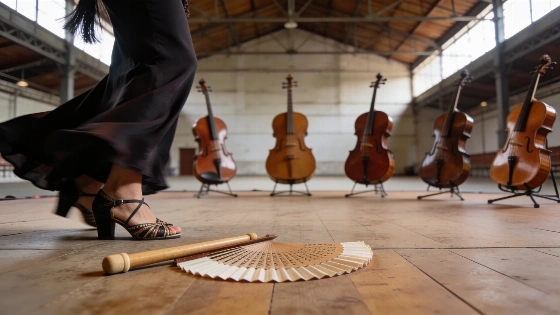
The production strips the stage down to essentials. Six musicians accompany Pagés. At times, they seem to shelter her instead of acting as a simple musical backdrop. The violin played by Graci del Saz and the cello performed by Alicia Avilés are especially moving.
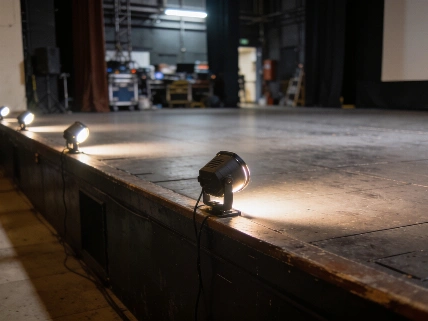
Nave 11 at Matadero keeps its industrial scale and bare grandeur. An abanico, a bastón, a bata de cola, books and shoes provide the concrete objects of recollection.
According to RTVE's coverage, the autobiographical line reaches back to Pagés's arrival in Madrid as a teenager and the early professional path that followed. That account supports the sense that Bilbao Square is more than a return to earlier repertoire. It is a stage memoir where direct narration and flamenco share the same dramatic space.
The Centro Danza Matadero presents the production as one of the season's central premieres. Audiences aged 16 to 30 can also attend free through the JOBO programme. The scheme widens access to a work about the making of an artist in the city.
At the premiere, Pagés sat beside Pedro Almodóvar in the audience before the performance began. That image belongs to the event's atmosphere. The real achievement lies elsewhere.
Bilbao Square makes a private family journey clear without reducing it to biography. María Pagés revisits the girl who arrived in Madrid. She also shows how memory can become choreography and how restraint can carry more force than display.
This is difficult work. It is artistically mature, and its simplicity gives the central story room to breathe.