At least several hundred people marched across Madrid on 7 October after 87-year-old Maricarmen Abascal died following her eviction. Candles, poems and a manifesto turned the housing protest into a public vigil outside Congress.
At 20.30 on 7 October, protesters held a minute of silence at Puerta del Sol for 87-year-old Maricarmen Abascal, who had died earlier that day at Hospital Gregorio Marañón. She was evicted from her Madrid home on 23 September, and her case had already become a symbol of the housing crisis.
The gathering soon moved beyond mourning. More people joined the camp and marched towards the Congreso de los Diputados, calling for action on evictions and housing costs. RTVE reported that the protests after Abascal's eviction helped push housing to the centre of Spain's national political debate.
Maricarmen Abascal had lived in the apartment on Madrid’s Alcalde Sáinz de Baranda street for around 70 years. Independent reports said police forced open the door during the eviction and that she was carried from the home on a stretcher.
Police protected the march as it reached the Congress. Demonstrators demanded an end to evictions and accused the Government of failing to deal with the housing emergency. The Congress had appeared in an earlier report about a separate Madrid event, but on this night it became the destination for a protest shaped by grief and anger.
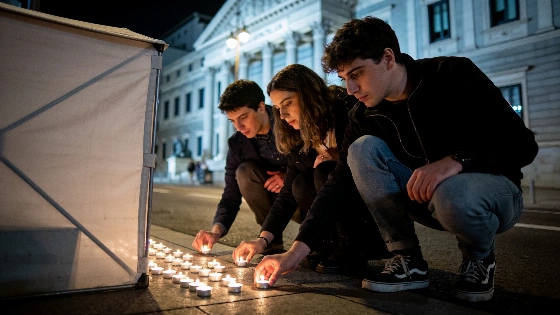
Near the chamber, protesters sat down, lit candles and read a manifesto. They also read poems by Rafael Alberti. Later, the anger gave way to a quieter commemoration, though several hundred people stayed in the area. Reports reviewed for this account confirm the vigil and its route. They do not independently establish the full composition of the crowd or the complete contents of the manifesto.
The mobilisation around the eviction was followed by broader political consequences. CCOO and UGT announced a 24-hour general strike for 11 November, while reports linked the housing protests to an early election call and a wider national debate over housing policy.
Sol became a collective wake.
People placed candles around the tents and set up two memorial points. One stood outside the Real Casa de Correos, the headquarters of the Comunidad de Madrid presidency. The other was at the junction of Sol and calle del Carmen, where people left flowers, candles and banners with Maricarmen's name. The encampment began after the eviction as part of a wider campaign for the right to housing.
A third gathering formed outside Maricarmen's home on calle Sáinz de Baranda. Several dozen people stood there with candles. The protest reached beyond central Madrid and returned to the place where she had lived.
Estrella Banudu of the Sindicato de Vivienda de Tetuán said the movement would keep using every available tool. She rejected the succession of government decrees as insufficient. Her statement reflected the protesters' position: parliamentary measures will not be accepted as an answer while people continue to face eviction.
Maricarmen's family called what happened a "torturous process" and said the eviction was an injustice that triggered large protests, encampments and a political crisis. She remained in hospital for roughly two weeks after the eviction. No specific official medical cause of death has been made public, so the available reports do not establish a direct medical link between the eviction and her death.
By night, the mobilisation had three centres: Puerta del Sol, the area around the Congreso de los Diputados and Maricarmen's home. The three locations brought together the protest camp, the political demand and the personal memorial. The candles stayed at the camp, outside Parliament and near the apartment on calle Sáinz de Baranda.