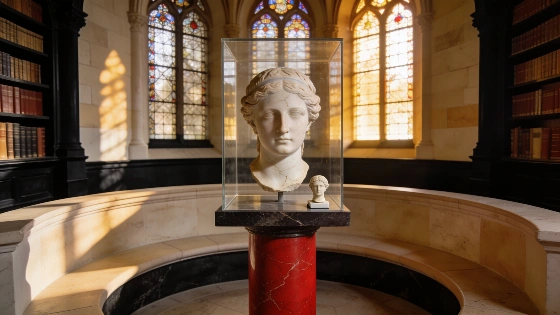
A Roman marble head discovered during works to condition Almadraba beach, in an archaeological setting linked to the Almadraba villa and ancient Lucentum, is the focus of the first exhibition in the MARQ’s history devoted entirely to a single object. “Venus, una mirada desde el Alicante romano” opened to the public on 18 November 2026 in the Sala Noble of the former Provincial Hospital library, according to the MARQ. The exhibition is scheduled to run through 10 January 2027.
The museum describes the sculpture as the largest Roman sculpture discovery in Alicante’s history. It was found during the beach works and dates to the High Imperial period, between the first and second centuries AD. Director Manuel Olcina places it within the villa’s high-imperial Roman occupation and says it was probably displayed in a wealthy domus in the area. He also said the find points to a level of luxury and wealth previously unknown in the archaeological context there. The head weighs 14 kilograms and measures 22.22 centimetres high by 19.78 centimetres wide.
The marble’s origin remains under investigation. María del Pilar Lapuente, a petrology professor at Universidad de Zaragoza, is analysing whether it came from the Greek island of Paros or Docimium, near present-day Afyon in Turkey. José Manuel Pérez Burgos, head of Integral Heritage at Alicante City Council, said the sculpture’s beauty and state of preservation stood out. He added that a Docimium origin would make the piece still more exceptional, since that quarry operated for a shorter period and produced less marble. The exhibition also features preliminary findings from an ongoing study by a specialist in Roman sculpture.
Designer Rafael Pérez placed the head at the centre of the apse in the former chapel of the Provincial Hospital, now a library. It rests on a 220-kilogram column of red Alicante marble from the Romaneta quarry. Beneath it sits a black Marquina marble base made by sculptor Miguel Bañuls. The sculpture’s translucent white marble joins these materials in an echo of colours associated with Roman mosaics and Alicante’s Explanada promenade.
Small methacrylate springs hold the head as if suspended in the air. Pérez said the detail pays tribute to the kinetic work of Eusebio Sempere. The original is protected behind glass, while a touchable replica stands opposite it to give visitors with visual disabilities tactile access. Visitors can also use the replica’s Braille text and QR code to hear an audio explanation.
The exhibition’s interpretive panels cover Roman Lucentum, the Almadraba villa and the sculpture’s historical and artistic setting. Admission is free, but visitors must reserve in advance because capacity is limited. After the temporary display, the sculpture is expected to join MARQ’s permanent collection. A separate report on the Sijena paintings covered the start of dismantling work; the MARQ display instead protects the original behind glass and pairs it with a tactile replica.