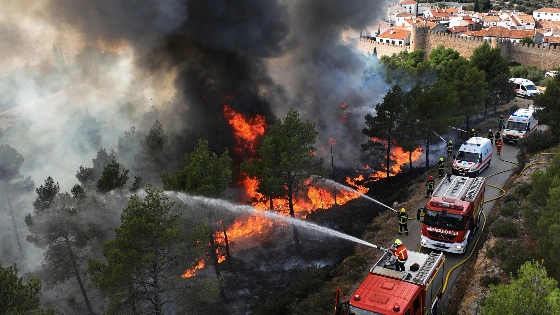
Wildfires in Madrid and Ávila have forced 100,000 people to evacuate or shelter. Authorities struggle to contain the flames as strong winds persist. The government has now declared a national emergency in Toledo.
Wildfires raging across Madrid and Ávila have triggered the evacuation or confinement of around 100,000 residents, with the fires now affecting 45,000 hectares. Emergency services remain on high alert as both blazes continue to spread, driven by persistent winds that have complicated firefighting operations for four consecutive days. The government has responded by extending the national emergency to include Toledo, reflecting the growing scale of the crisis.
Efforts overnight focused on protecting towns and preventing the two main fire fronts from merging. According to the Unidad Militar de Emergencias (UME), the fires are now being managed as a single incident, though they have only connected through a narrow, discontinuous front. The separation between the two main blazes is estimated at about 15 kilometers, and authorities believe they have managed to halt the internal advance of the flames, though the perimeter remains unstable.
Weather remains the critical factor. While meteorologists expect slightly improved conditions, with weaker winds compared to previous days, the unpredictability of gusts—especially in mountainous areas—continues to pose a threat. On Saturday, wind speeds exceeded 50 km/h in Ávila and 40 km/h in Madrid, hampering containment efforts. The fires themselves are altering local weather patterns, making precise forecasts difficult and complicating the response strategy.
In Madrid’s Sierra Oeste, the fire has already consumed 24,000 hectares and remains uncontained. Firefighters took advantage of calmer conditions overnight to reinforce defenses, but shifting winds remain a concern. Twelve municipalities in Madrid have been evacuated, with four more under confinement orders. In total, nearly 30,000 people have been forced from their homes, and over 21,000 are sheltering in place.
Meanwhile, the Burgohondo fire in Ávila continues to advance southward, threatening the Valle del Tiétar. Fire crews have intensified their efforts to protect local communities, with 21,000 hectares already burned. Approximately 30,000 residents from 16 municipalities have been evacuated, and another 8,000 are confined. Authorities warn that more evacuation alerts may be issued as the situation evolves. In Toledo, 5,000 people from 11 towns have also been evacuated as the emergency expands.
This escalation follows a pattern seen in previous years, where extreme weather and wind have repeatedly complicated wildfire containment in central Spain. As highlighted in a recent report on similar events, mass evacuations and widespread disruption have become increasingly common during severe fire seasons.
Spain’s wildfire season has grown longer and more intense in recent years, with climate conditions and land management practices both contributing to the risk. The current crisis underscores the vulnerability of rural and peri-urban communities to fast-moving fires, especially when strong winds and dry conditions coincide. Emergency services continue to prioritize the safety of residents and the protection of critical infrastructure, but the situation remains fluid as authorities monitor weather changes and fire behavior.