Tens of thousands gathered across Catalonia to witness a rare total solar eclipse. Major roads and train stations were overwhelmed, with authorities activating emergency alerts. The next such event is not expected for over a century.
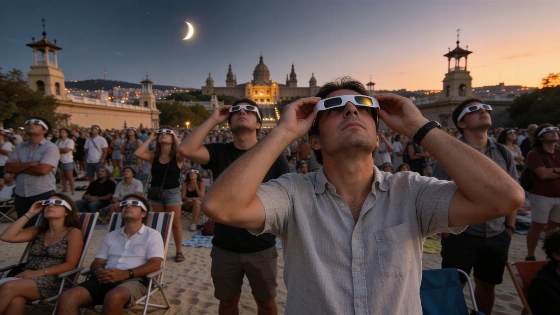
On Wednesday evening, Catalonia experienced a rare total solar eclipse, drawing unprecedented crowds to key observation points and causing widespread disruption across the region. In Barcelona, hundreds gathered at Montjuïc Castle, turning their backs on the city to focus on the western sky as the moon gradually obscured the sun. Excitement peaked just after 8 p.m., when the daylight dimmed and the atmosphere shifted, with children and adults alike expressing awe at the spectacle.
Elsewhere in the city, popular vantage points such as the Carmel bunkers were packed well before sunset. By 20:22, the sun remained high and unobstructed by clouds, but the city was plunged into an eerie twilight. In Tarragona and Lleida, thousands flocked to locations within the eclipse's path of totality, including the port of Tarragona, where the full shadow appeared at 20:29, marking a moment that will not be repeated in Catalonia for more than a hundred years.
Many traveled significant distances for the event. Maria Rosa, 77, made her way to Móra la Nova in Tarragona with friends from Turin, recalling her first eclipse at age 14. Groups arrived early, braving 37-degree heat and seeking shade under olive trees, equipped with food, drinks, and even custom eclipse quizzes. Móra la Nova was one of 23 official observation sites designated by the Generalitat, with visitors arriving from midday to secure a spot and escape the sun.
Among the crowd were both seasoned eclipse chasers and first-timers. Lluís Jardí, an IT professional from Sant Cugat del Vallès, attended his third total eclipse, joined by his son and friends. Others, like Felip Sarroca from El Prat de Llobregat, relied on AI tools to select less crowded viewing locations, demonstrating the lengths enthusiasts went to for the best experience.
Local facilities adapted to the influx. The primary care center in Móra la Nova served as a climate refuge, with staff preparing for possible heat-related incidents and eye injuries. The nearby senior center opened its doors to visitors, offering restrooms and a cool place to wait, while regular activities like bingo continued alongside the astronomical event.
Transport infrastructure struggled to cope with the surge. Major highways such as the AP-7, C-32, and A-2 saw kilometers of traffic jams as vehicles headed south toward Tarragona and Lleida. Train stations, particularly Barcelona Sants, were overwhelmed by travelers, with delays caused by technical issues at Castelldefels. Civil Protection activated alerts for overcrowding at key stations, and the Generalitat anticipated up to 50,000 people would be on the move.
In Barcelona, the streets leading to Montjuïc were filled with people carrying protective glasses and beach chairs, determined to secure a view. The castle's surroundings and interior terrace were at capacity, with both ticket holders and spontaneous visitors vying for space. For many, it was their first eclipse, and the sense of witnessing a unique historical moment was palpable.
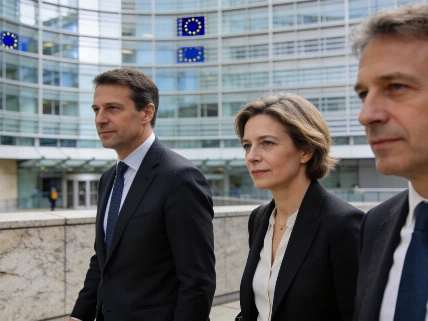
Government officials, including President Salvador Illa and several consellers, observed the eclipse from the Ebro Observatory in Roquetes, Tarragona. Despite earlier concerns about cloud cover, the event was visible and streamed live on YouTube, though only a small online audience tuned in. The scale of public participation and the logistical challenges echoed predictions made in advance, as highlighted in reports on the expected influx and preparations.
Solar eclipses of this magnitude are rare in Spain, with the next total eclipse not expected in Catalonia for more than a century. Such events require careful planning due to the risks of eye injury and the strain on public infrastructure. The 2026 eclipse demonstrated both the enduring fascination with astronomical phenomena and the challenges of managing mass public interest in real time. For many, the experience was a once-in-a-lifetime opportunity, blending scientific wonder with the realities of modern urban life.