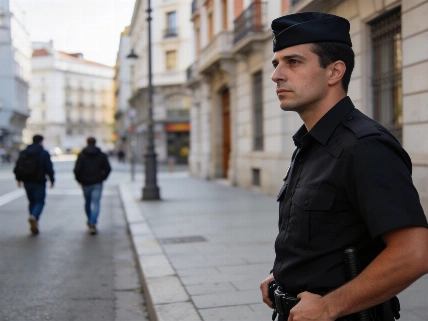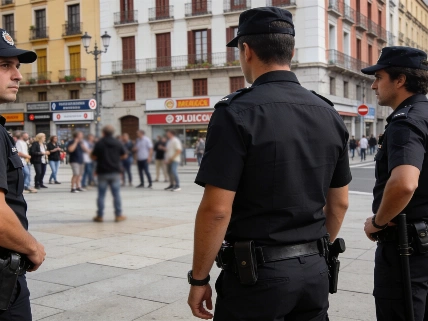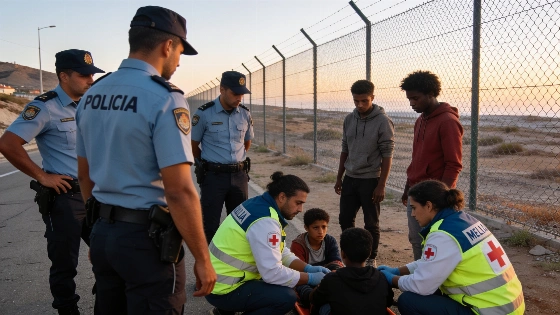
Melilla faced a new wave of migrant attempts after its border closure. Authorities report 130 arrivals, most of them minors. Security forces and medical teams remain on alert as tensions persist at key crossing points.
Melilla has managed to contain a surge in migrant pressure at its closed border, with authorities confirming that 130 people, including 84 minors, entered the city following a night marked by heightened tension and repeated attempts to breach the perimeter. The situation unfolded as images of chaotic crossings in Ceuta circulated widely, prompting groups in Melilla to attempt similar actions, according to the Government Delegate, Sabrina Moh.
Despite the border closure at Beni Enzar and a significant police deployment, the city experienced a series of coordinated entry attempts at multiple points, including the old Barrio Chino and Farhana crossings, as well as by sea at the southern breakwater. Moh described the night as “complex,” with groups of 200 to 300 migrants repeatedly dispersing and regrouping to try new entry points. The exact number of those who attempted to cross remains unclear, but estimates suggest it could have exceeded 1,000 or even 2,000 individuals.
All 130 migrants who managed to enter Melilla remain in the city. The minors are under the care of local authorities, while adults are undergoing identification procedures by the police. The Temporary Stay Centre for Immigrants (CETI) has activated its contingency plan and, according to officials, currently has sufficient capacity to handle the arrivals.
On the Moroccan side, the Asociación Marroquí de Derechos Humanos (AMDH Nador) reported a sharp escalation in violence, with security forces using riot control equipment, including rubber bullets and tear gas. Numerous injuries were recorded among both migrants and officers, with several requiring hospital treatment at El Hassani. Three police vehicles were set on fire during the clashes, and at least 100 people were returned to Morocco overnight, with authorities documenting and publicizing these returns.
The confrontations began at Beni Enzar and later spread to Farkhana and Barrio Chino, despite a heavy Moroccan security presence. AMDH Nador noted that the response in Melilla differed from previous incidents at Fnideq (Castillejos, on the Ceuta border), expressing concern over the severity of force used against vulnerable individuals. For now, Moroccan authorities consider the situation under control, but a new complication has arisen as a lawyers’ strike in Morocco could hinder legal assistance for detainees.
Medical services in Melilla treated 60 people for injuries, mainly fractures and open wounds, with three requiring hospital admission. Among the injured were three officers—two from the National Police and one from the Guardia Civil. Most injuries were attributed to falls during the crossing or alleged aggression by security forces, with many patients suffering abrasions and cuts needing urgent care. Some cases were still awaiting diagnosis or treatment by midday.
Authorities have not ruled out further attempts to cross the border in the coming nights but state they are prepared to respond. Sabrina Moh urged calm among residents, warning against misinformation and false videos circulating on social media. She also denied claims that 400 migrants entered the city overnight, countering statements made by Melilla’s president, Juan José Imbroda, which had caused significant public concern.
Melilla, along with Ceuta, represents one of the European Union’s only land borders with Africa, making it a frequent focal point for migration attempts. The city’s border infrastructure and response protocols have been repeatedly tested in recent years, with authorities balancing humanitarian obligations and security concerns. The ongoing situation highlights the challenges faced by both Spanish and Moroccan officials in managing migration flows, especially as regional instability and economic hardship continue to drive movement toward Europe.