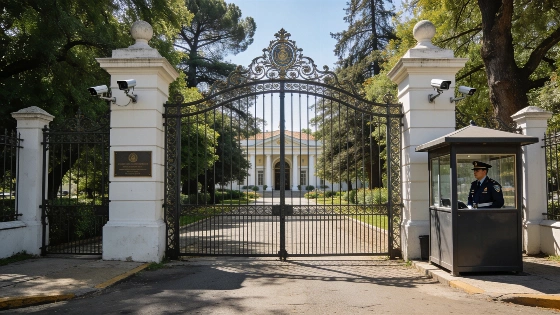
Javier Milei has ordered military personnel to take over management of the Olivos presidential residence, following the release of troubling economic data and a public attack on the press. The move has fueled concerns about his leadership and Argentina's political climate.
Argentina’s political scene shifted abruptly after President Javier Milei announced that military personnel would take over management of the Olivos presidential residence, replacing the civilian staff. The decision followed official data showing a 0.6% drop in GDP for the last quarter, driven by lower consumption and investment, and a record 45% informal employment rate—meaning 6.1 million Argentines now work without formal contracts. According to government statements, the Casa Militar will now be responsible for security at Olivos and the president's temporary residences, with officials saying the change is meant to strengthen security and streamline internal processes.
Several Argentine media outlets, including La Nación, reported that at least 12 civilian staff members were dismissed from the Quinta de Olivos as part of the transition. The Casa Militar is taking over not only security but also some administrative coordination. The government has stressed that this is not simply a case of "military in the kitchen," but a broader change in how the residence is managed. The transition is expected to finish within 60 days. Officials have linked the decision to security concerns, citing risks to information and the need for better protection of the president and his family, rather than the recent economic data.
Over the past year, Argentina lost 121,000 formal private sector jobs and 30,500 public sector jobs, according to official labor statistics.
Within hours of these figures making headlines, Milei posted a series of insults against journalists on his X account, calling them “repugnant trash” and “human filth who do nothing but lie.” The posts, written in all caps and without further explanation, highlighted his growing hostility toward the media. The timing suggested that the negative economic news had set off his latest outburst. Still, according to EFE and other sources, the government insists the staff changes at Olivos are unrelated to the economic data or media disputes, and are instead part of a broader response to what officials describe as a "rise in global insecurity" and upcoming high-profile visits, such as that of Pope Leo XIV.
Argentina’s main press association, ADEPA, has warned that Milei’s repeated attacks on journalists and media outlets are fueling a “contagion effect” in society. ADEPA reports that between August 17 and 23, Milei’s account republished 335 messages targeting the press, along with 26 original posts and 21 public remarks criticizing journalism. This pattern is documented in ADEPA's 64th assembly report, which details the president's use of social media to undermine the press.
Meanwhile, the Association of State Workers (ATE), Argentina’s largest public sector union, has formally requested information from the government about Milei’s physical and mental health. The union cited statements from mental health professionals, including psychiatrist Graciela Peyrú, who described Milei as showing “manic traits” such as grandiosity, lack of self-criticism, and irritability. Psychiatrist Enrique Stola also raised concerns about Milei’s “emotional instability” and verbally aggressive behavior. Vice President Victoria Villarruel has publicly expressed unease about the president’s state of mind and what she called his “imaginary persecutions.” Journalist and physician Nelson Castro went further, saying Milei has “a psychiatric problem.”
Argentine media have noted that the Casa Militar's new responsibilities at Olivos include not only security but also administrative coordination, though military personnel are not expected to perform all domestic tasks themselves. The official transition period is set at up to 60 days, and the change comes amid heightened security demands and upcoming international visits.
Argentina’s presidency is now marked by economic strain, institutional turbulence, and a leader whose confrontational style is drawing scrutiny from both the media and within his own administration. The replacement of civilian staff with military personnel at Olivos is more than a security measure—it reflects a presidency increasingly defined by volatility and personal conflict. As the country faces mounting economic and social challenges, Milei’s approach is raising concerns about deepening divisions and confidence in Argentina’s democratic institutions.