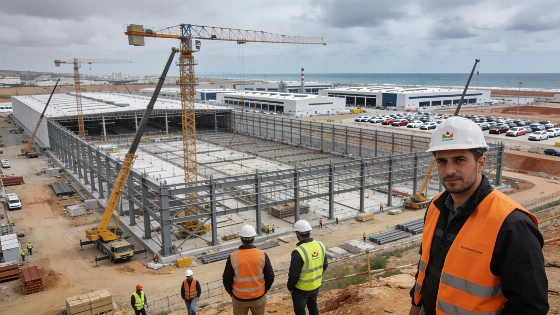
A $6.8 billion battery plant is rising in Kenitra, Morocco, only 15 kilometers from Spain. With Chinese giant Gotion High-Tech behind it, this project could shake up the electric vehicle race in southern Europe.
Morocco has put Spain’s electric car industry on notice. The country signed a $6.8 billion deal with China’s Gotion High-Tech to build Africa’s first battery gigafactory in Kenitra, just north of Rabat. This plant is set up to supply batteries to both Moroccan and southern European carmakers, putting Spanish battery projects in Valencia, Zaragoza, and Extremadura under real pressure.
Gotion High-Tech, working through its local branch Gotion Power Morocco, is building the factory inside Kenitra’s Atlantic Free Zone. The location is no accident. Stellantis and Renault already assemble up to 700,000 vehicles a year in this corridor. The gigafactory will start with a capacity of 10 GWh a year. That’s enough for more than 100,000 electric cars or for storing extra energy from big solar parks. The plan is to ramp up to 100 GWh, which would put Kenitra in the same league as the biggest battery plants in Europe and Asia.
The investment agreement for the Kenitra gigafactory was officially signed in Rabat in June 2024, with a commitment to create 17,000 jobs, including 2,300 direct positions in the first phase.
The Kenitra plant will use LFP (lithium iron phosphate) battery technology. This chemistry builds the cathode right into the cell, which cuts costs and makes the batteries safer in terms of heat. LFP batteries don’t pack quite as much energy as NMC (nickel-manganese-cobalt) types, but for mass-market electric cars and stationary storage—the main targets for Kenitra—they are the most cost-effective choice right now.
China’s play is simple: move battery production closer to Europe, cut shipping costs, and beat rivals by supplying car factories from just across the Strait of Gibraltar. Kenitra is only 15 kilometers from Algeciras, Spain’s southernmost port. That makes it a direct competitor to Spanish battery projects that are still in the planning stage.
Morocco is aiming higher than its old mainstays like fishing and farming. The country is expanding the port of Nador to compete with Algeciras and Alicante. It’s building up an industrial network: parts suppliers, direct shipping routes to the Mediterranean and Atlantic, EU trade deals, and labor costs much lower than Europe’s. Stellantis, for example, plans to more than double its Kenitra output to 535,000 vehicles a year by 2025, focusing on small electric cars like the Citroën Ami, Opel Rocks-e, and Fiat Topolino.
According to SiliconValley.ma and Renewable Watch, the total investment in the Kenitra gigafactory could reach up to 65 billion dirhams as the project expands in future phases, making it one of the largest battery investments on the continent. The African Development Bank has already approved a €100 million loan for the project, with the possibility of mobilizing an additional €141 million from other partners.
Khalid Qalam, who leads Gotion Power Morocco, says batteries from Kenitra will mainly go to Morocco’s car plants and to southern Europe through existing supply chains. That includes Spain. The project has a €100 million loan from the African Development Bank, with another €141 million expected from partner institutions.
Spain’s own gigafactory plans are still at the early stage. PowerCo, Volkswagen’s battery arm, is building a plant in Sagunto (Valencia) with an initial 40 GWh capacity, expandable to 60 GWh, but production won’t start before 2026. Stellantis and CATL have started work in Figueruelas (Zaragoza) on a 50 GWh plant, with test cells due at the end of that year. Envision AESC is preparing a 30 GWh plant in Navalmoral de la Mata (Extremadura), aiming for the second half of 2027. Even Gotion has a project in Valladolid—€940 million for a plant with recycling and cathode integration—but construction hasn’t begun yet.
This puts Gotion on both sides of the Strait, with projects in Morocco and Spain. The real race is inside the company: which plant opens first, which lands the best supply deals, and which supply chain takes the lead.
Spain is not about to lose its car industry overnight. It’s still a major player in Europe. But the bigger risk is structural. If Kenitra starts locking in low-cost electric models, battery contracts, and the most profitable parts of the value chain before Spanish plants are up and running, Spain’s long experience and strong supplier networks may not be enough to keep production at home.
Spain’s strengths—deep production know-how, full access to the EU single market, a strong supplier base, and technical talent—are real. But they need defending. That means faster permits, cheaper energy, targeted training, and bringing in electric models that make it worth keeping factories in Spain. As the industry shifts to electric, whoever controls the battery supply will decide which factories survive. Africa’s first battery gigafactory now has a clear address: Kenitra, Morocco.
For context, Spain’s electric car sector has seen bold moves before, as reported earlier with the Liux BIG’s pre-launch reservations. But Morocco’s project, with Chinese money and multilateral backing, is moving faster and on a bigger scale. It marks a new phase in the race for electric mobility in the region.