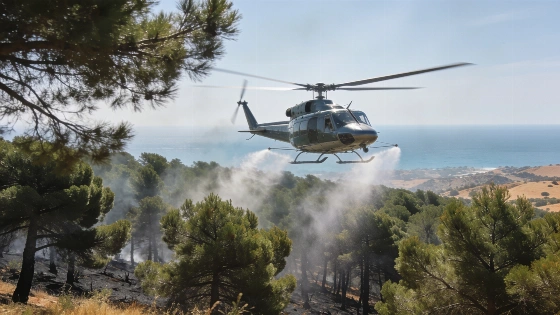
The treatment is timed for the pine processionary’s early larval stages, before the caterpillars develop urticating hairs that can affect people and animals. The aerial campaign is due to begin on Monday, although rain or wind may change the flight schedule.
Helicopters are scheduled to cover about 2,400 hectares of public woodland across Murcia, Santomera, Calasparra and Lorca. The work will focus mainly on repopulated stands of Aleppo pine where monitoring has found infestation levels that warrant intervention. That is 50 per cent more land than the 1,600 hectares treated in 2024.
Inmaculada Torres, director general for Natural Heritage and Climate Action, said the operation is preventive and limited to places where prior monitoring identified a need for treatment. The biological product, Bacillus thuringiensis var. kurstaki, acts specifically on larvae and has an active substance approved for use in organic farming.
Crews will apply it using ultra-low-volume technology. Helicopters will use Differential Global Positioning System navigation to define treatment areas and adjust the dose. Together, the systems are meant to keep spraying within the identified zones.
Those zones will be marked with notices at least two days before flights, while the Environmental Agents Corps will help control access during operations. A 100-metre untreated buffer will be maintained around urban areas. The same distance will apply around watercourses and water points, as well as beehives; beekeepers in affected areas will be notified in advance.
Aerial spraying is one part of a year-round control programme. It also includes biological ground treatments in recreational and heavily used areas, along with the removal and treatment of caterpillar nests. Nest boxes for insectivorous birds and bat shelters are installed as part of the strategy. Environmental agents also check a network of 70 pheromone traps each week. A separate crop-pest trial in Almería used red mesh against tobacco thrips, covered in an earlier pest report.
For winter, the advice is to avoid touching nests or caterpillars and to keep children and dogs under close watch in pine areas and gardens. Anyone who comes into contact with them should wash the affected area with plenty of water without rubbing it, then seek medical or veterinary help if a reaction develops.