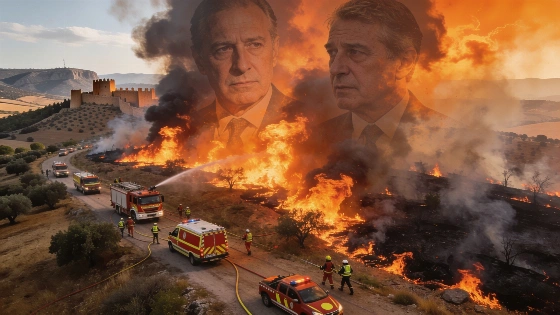
Spain’s government has declared a national emergency after severe wildfires hit Madrid and Ávila. The crisis has triggered sharp exchanges between central and regional leaders, exposing deep political divides.
Spain’s central government has declared a national emergency in response to the escalating wildfires devastating the Community of Madrid and the province of Ávila. The move, prompted by a formal request from Madrid’s regional president Isabel Díaz Ayuso, has intensified political tensions as authorities coordinate efforts to contain the crisis.
Prime Minister Pedro Sánchez convened the State Coordination and Direction Committee (CECOD) at La Moncloa, emphasizing the gravity of the situation and pledging full support for affected communities. Sánchez described the fires as “dramatic” and assured that all available resources, including the Military Emergency Unit (UME), Civil Protection, and security forces, are being mobilized to fight the flames and support recovery efforts.
Initial criticism emerged from the government’s delegate in Madrid, Francisco Martín, who questioned the thoroughness of the region’s emergency request, suggesting it lacked sufficient detail for such a serious matter. Despite this, the central government quickly approved the emergency status, underscoring the urgency of the situation.
Interior Minister Fernando Grande-Marlaska, speaking from the Advanced Command Post in Cenicientos (Madrid), clarified that the central government’s role is to act decisively when a region cannot manage an emergency alone. He cited the aggressive nature of the fires, their proximity to urban areas, and adverse weather conditions as justifications for the national intervention, warning that the coming hours would be critical.
However, the government’s unified front fractured when Transport Minister Óscar Puente took to social media, accusing the Partido Popular (PP) of underfunding public services and then relying on the central government to resolve crises. Puente’s remarks referenced the UME, a force established in 2005 under José Luis Rodríguez Zapatero’s Socialist government, which was initially criticized by the PP but has since become a key asset in disaster response.
Ayuso responded sharply, defending the coordination between regional and national authorities and dismissing Puente’s comments as unhelpful. She stressed that the priority must be saving lives and property, not fueling political disputes. Alma Ezcurra, the PP’s Deputy Secretary for Sectoral Coordination, echoed this sentiment, condemning Puente’s attitude as “miserable” and insisting that the focus should remain on the emergency, not partisan divides.
Alfonso Fernández Mañueco, president of the Junta de Castilla y León, also weighed in, highlighting what he described as effective cooperation between the central government and affected regions. The debate over the UME’s role and the responsibilities of regional versus national authorities has a long history in Spanish politics, as seen in other high-profile cases involving government intervention. For example, the involvement of former Prime Minister Zapatero in public aid decisions was previously scrutinized in the context of airline bailouts, as detailed in this report on political influence in Plus Ultra’s rescue.
The current wildfire emergency highlights the ongoing challenges of disaster management in Spain’s decentralized system. While the immediate focus remains on extinguishing the fires and protecting residents, the crisis has reignited debate over the balance of power and responsibility between regional governments and Madrid. The UME, once controversial, is now widely recognized for its rapid response capabilities, but questions persist about long-term funding and the adequacy of regional emergency services. As climate risks intensify, such disputes are likely to shape future policy and political dynamics across Spain.
Spain’s approach to wildfire management has evolved significantly over the past two decades, with the UME playing a central role in national disaster response. The unit’s creation followed a series of devastating fires and floods, prompting a shift toward greater central coordination. Today, the UME is deployed not only for wildfires but also for floods, earthquakes, and other emergencies, often working alongside regional and local agencies. The current crisis in Madrid and Ávila underscores the importance of clear protocols and robust cooperation, especially as extreme weather events become more frequent. The debate over funding, jurisdiction, and political accountability remains unresolved, but the immediate priority for authorities is to bring the fires under control and support affected communities.