Spain's government has assumed control over wildfire response in Madrid and Ávila. Over 10,000 people have been evacuated. Extreme weather and multiple fires have overwhelmed local resources.
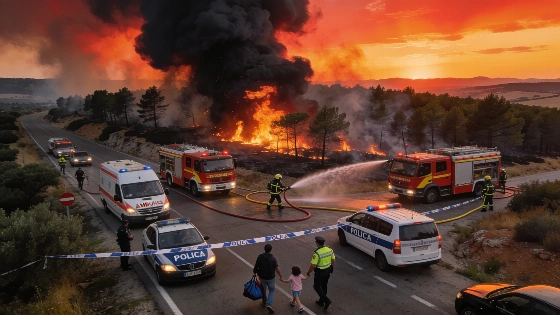
Spain's central government has declared a national emergency in the Community of Madrid and the province of Ávila after a series of wildfires forced the evacuation of more than 10,000 residents and stretched local firefighting resources to their limits. The unprecedented move came late at night, following a direct request from Madrid's regional president, Isabel Díaz Ayuso, who acknowledged the region could no longer manage the crisis alone.
Three major fires—two in Villa del Prado and one in San Martín de Valdeiglesias—have been burning simultaneously in Madrid's western sierra, while a fourth blaze in Burgohondo, Ávila, threatens to cross into Madrid territory. The government cited the combination of multiple active fires, exceptionally adverse weather conditions, and the need to mobilize significant resources from various public administrations as key reasons for escalating the emergency to the national level.
Interior Minister Fernando Grande-Marlaska assumed command of the emergency response at midnight, as stipulated by Spain's Civil Protection law. The operational leadership has been assigned to Lieutenant General Francisco Javier Marcos Izquierdo, head of the Unidad Militar de Emergencias (UME). At the time of the decision, more than 270 professionals and 40 ground vehicles were deployed in the affected areas, including UME units and regional emergency services.
Evacuations have impacted not only local residents but also vulnerable groups. Four care homes in the region have been cleared, with elderly and disabled residents relocated to safer facilities in nearby towns. In San Martín de Valdeiglesias, most care home residents are being sheltered in the municipal sports center, while the most fragile have been transferred to a public residence. Authorities have kept families informed about the ongoing relocations and are preparing additional facilities in case further evacuations become necessary.
In Ávila, the fire that began in Burgohondo has led to the evacuation of 1,500 people from a rural tourism area and a residential development in El Tiemblo, as flames advanced rapidly. The situation has also forced the removal of 130 campers from two local campsites. Regional officials, including the president of Castilla y León and the director general of Civil Protection, have emphasized the coordinated effort among all levels of government to prioritize public safety.
Transport has been severely disrupted, with five regional roads closed due to fire activity. In Villa del Prado, both the M-507 and M-540 are shut in both directions, while the M-501 and M-541 are closed near San Martín de Valdeiglesias and Pelayos de la Presa. Additional closures affect the M-206 in Loeches, where a separate fire has blocked a service road. Road maintenance teams remain on site to monitor conditions and reopen routes as soon as it is safe.
The government’s decision to take over the emergency response followed initial hesitation from the central delegate in Madrid, Francisco Martín Aguirre, who questioned the adequacy of the region’s formal request. He noted that the documentation provided was minimal and lacked detailed justification, but the escalation of the crisis prompted swift action within hours.
Spain has faced a series of severe wildfires in recent years, with high temperatures and unpredictable winds complicating firefighting efforts. The current situation in Madrid and Ávila highlights the growing challenges posed by extreme weather and the need for rapid, coordinated responses. For context, recent infrastructure projects in Madrid, such as the new Gran Vía del Sureste, have also been shaped by the region’s evolving approach to environmental risks and emergency planning, as seen in the city council’s approval of major green corridors and transport upgrades (details on Madrid’s urban development).
Spain’s Civil Protection framework allows the national government to assume control in situations where regional resources are insufficient or when emergencies cross administrative boundaries. The current deployment of military and civil protection units underscores the seriousness of the threat and the priority placed on safeguarding lives and infrastructure. As the fires continue to burn, authorities remain focused on containment, evacuation logistics, and restoring normalcy to the affected communities.