Madrid City Council has greenlit the first 560 meters of Gran Vía del Sureste. The €13.1 million project will create a green corridor, new bike lanes, and space for future rapid bus transit. Completion is set for spring 2028.
The Madrid City Council has authorized the construction of the initial 560-meter stretch of Gran Vía del Sureste, a major green boulevard set to transform the Ensanche de Vallecas district. With a budget of €13.1 million, the project aims to convert a neglected urban gap into a vibrant public space, featuring wide pedestrian areas, dedicated cycling paths, and a reserved lane for a future Bus Rapid Transit (BRT) system. Work is scheduled to begin in September, with completion expected by spring 2028.
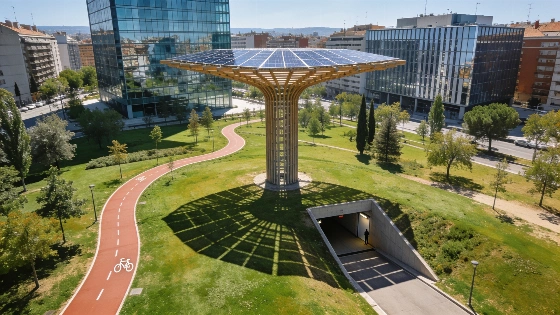
This first phase will run between the roundabout near the M-45 and Avenida del Ensanche de Vallecas, targeting an area that, despite being part of Madrid’s recent urban expansion, still lacks proper infrastructure. The plan includes a central boulevard spanning over 21,000 square meters, surrounded by greenery and designed to prioritize walking, cycling, and sustainable mobility. According to city officials, the intervention is intended to improve environmental quality and encourage residents to choose alternatives to private cars.
The new avenue will be lined with 875 trees and more than 86,000 shrubs and plants, supported by efficient irrigation systems and LED lighting. Urban furniture, children’s play zones, calisthenics areas, and a decorative fountain—envisioned as a neighborhood meeting point—will be distributed along the route. A dedicated corridor for the future BRT will allow high-capacity buses to connect the southeast’s new developments, separated from regular traffic.
While the transformation of public space has been broadly welcomed by opposition parties, criticism has focused on the project’s timeline and planning. The Socialist group argues that green spaces, bike lanes, and public transport corridors have long been on their agenda, but accuses Mayor José Luis Martínez-Almeida’s administration of treating new neighborhoods as isolated islands rather than integrating them into a citywide mobility network. They highlight the ongoing challenge of ensuring effective public transport links to the rest of Madrid.
José Luis Nieto, councillor for Más Madrid, echoed these concerns, noting that the announcement comes 18 years after the area’s initial development and pointing to delays in other local infrastructure, such as access to Hospital Enfermera Isabel Zendal. He also questioned why the city council, rather than the Los Berrocales Compensation Board, is overseeing the works, and criticized the lack of improved access to the A-3 motorway.
The Gran Vía del Sureste is envisioned as a 16-kilometer green corridor connecting six major southeast Madrid developments: Ensanche de Vallecas, Valdecarros, Los Berrocales, Los Ahijones, El Cañaveral, and Los Cerros. These areas are expected to accommodate tens of thousands of new homes in the coming decades, making the new boulevard a backbone for residential growth and a sustainable alternative to car travel. The design departs from traditional car-centric avenues, reducing space for vehicles and giving priority to pedestrians, cyclists, and public transport. In some sections, the boulevard will rival the width of Paseo de la Castellana.
This initiative is part of the city’s broader Southern Strategy, which seeks to address historic imbalances by channeling investment into Madrid’s southern and eastern districts. Alongside the Gran Vía del Sureste, the council is advancing other urban regeneration projects in Villa de Vallecas, Vicálvaro, Usera, Villaverde, Carabanchel, and Puente de Vallecas. The scale of planned housing is significant: Valdecarros alone is set to deliver over 50,000 homes, with other developments adding tens of thousands more. Ensuring robust public transport and sustainable mobility has been a longstanding priority for these expanding neighborhoods.
Madrid’s approach to urban transformation echoes debates seen in other Spanish cities, such as the controversy over the future of Valencia’s Mestalla stadium, where urban identity and development priorities have sparked public discussion. For example, the debate around Mestalla’s demolition highlights how large-scale projects can reshape city life and collective memory.
With the contract now approved, Madrid takes its first concrete step toward a project announced two years ago, aiming to redefine mobility and public space in the southeast. If the schedule holds, Ensanche de Vallecas will see the first completed section of what is set to become the main urban axis for Madrid’s largest residential expansion in decades.