Two commercial jets narrowly avoided a collision over the Canary Islands. Automated TCAS systems triggered emergency maneuvers. The incident raises new questions about air safety in oceanic sectors.
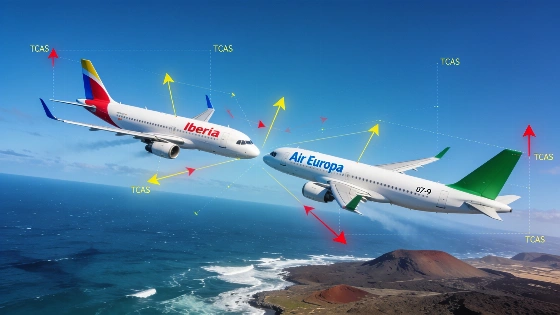
Two passenger aircraft, an Iberia Airbus A321 and an Air Europa Boeing 787-9, came dangerously close to colliding in the skies above the Canary Islands on July 10. The incident unfolded in the oceanic sector of the Canary Islands FIR/UIR, where both jets were flying at the same altitude but on opposite courses. According to the Sindicato de Controladores aéreos SIPCA, the situation escalated rapidly when onboard safety systems detected the conflict, prompting immediate action from both flight crews.
The critical moment occurred as the Iberia flight IBE0140 was traveling northeast along airway N857 at flight level FL360, between navigation points ETIBA and BIPET. Simultaneously, the Air Europa Boeing 787-9 was approaching from the opposite direction. Both aircraft received urgent instructions from their Traffic Collision Avoidance Systems (TCAS): the Iberia crew was ordered to descend by 500 feet, while the Air Europa pilots were told to climb by 400 feet. These automated advisories, known as TCAS Resolution Advisories (RA), are designed to be the final safeguard when all other layers of air traffic control have failed to prevent a conflict.
Thanks to the crews' prompt compliance with the TCAS commands, the two jets quickly altered their flight paths and the risk of collision was averted. No injuries or damage were reported, and both flights continued to their destinations without further incident. The event, officially recorded as IN-017/2026, has drawn renewed attention to the operational challenges in oceanic airspace, where radar coverage and radio communications are often less robust than over continental Europe.
Air safety in remote sectors like the Canary Islands relies heavily on automated systems and pilot vigilance, as traditional ground-based surveillance is limited. This near-miss underscores the importance of TCAS as a critical safety net, especially in regions where air traffic controllers have fewer tools at their disposal. The incident also echoes broader concerns about emergency response protocols in Spain, similar to recent discussions about the mandatory involvement of the Guardia Civil in V-16 beacon activations, as detailed in a related report on new emergency measures for Spanish drivers.
While no passengers or crew were harmed, the July 10 event serves as a reminder of the complexities and risks inherent in managing busy air corridors over the Atlantic. The reliance on TCAS in such environments is expected to remain a cornerstone of aviation safety, but the incident may prompt further review of procedures and technology in Spain's oceanic airspace. As air traffic continues to grow, especially in popular tourist regions like the Canary Islands, maintaining and enhancing these safety systems will be crucial for preventing future incidents.