Anna Netrebko returned to Barcelona after five years away. Her Aida opened the Liceu season amid protests and Shirin Neshat's fiercely anti-war production.
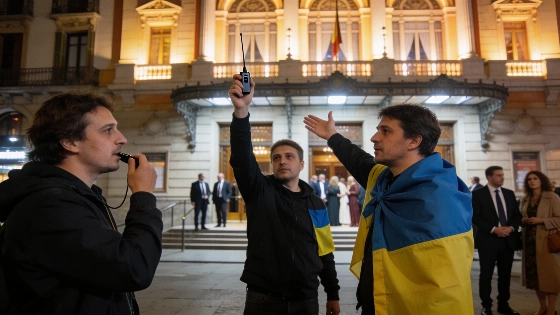
On 25 September 2026, Anna Netrebko arrived at Barcelona's Gran Teatre del Liceu for the season-opening Aida. Whistles and shouted insults came from outside. Just over a dozen protesters, most of them Ukrainians, challenged the Russian-Austrian soprano over her relationship with Vladimir Putin.
Inside, Netrebko gave the evening's strongest musical performance. Her authority grew as the opera moved forward.
Shirin Neshat's production puts war, exile and violence against women at the centre of Verdi's opera. Ancient Egypt disappears. In its place, projected images show prisoners, executions and massacres.
The result can be powerful and poetic. Its political message also overwhelms the private drama that gives Aida its force.
Aida opened the Liceu’s 2026/27 season on 25 September 2026, with performances scheduled in Barcelona through 15 October.
Netrebko began with an unstable emission. She soon found her authority.
Her third act was the high point. Warm, intense phrasing led to shining high notes and a memorable "O patria mia". Her duets with Amonasro and Radamès raised the performance's temperature and won an enthusiastic response.
Her acting was less convincing. Netrebko knows the role thoroughly, but her exaggerated, dated gestures weakened the character's emotional precision.
Antonello Manacorda gave the most balanced reading of the production. His conducting offered transparency, carefully judged contrasts and a sharp ear for orchestral detail.
The Liceu orchestra and chorus responded at a high level. Pablo Assante guided the chorus particularly well in the richly shaded Vulcano scene.
The protest reflected a wider dispute over Netrebko’s political history. Protesters referred to her support for Vladimir Putin in 2012 and criticised the absence of a public apology, while reports also noted that she condemned the war in Ukraine in 2022.
The rest of the principal cast gave a mixed performance. Ivan Gyngazov sang Radamès with substantial power and secure high notes, but showed little expressive nuance. His chemistry with Netrebko was limited.
As Amneris, Ekaterina Semenchuk was more elegant and controlled. She built towards a moving final scene.
Artur Ruciński brought polished phrasing and a beautiful voice to Amonasro. The character still lacked some authority.
Alexander Köpeczi was a powerful Ramfis. George Andguladze was less convincing as the King of Egypt. Moisés Marin sang the Messenger capably, as did Carmen Buendía as the Priestess.
Other scheduled performances will feature Anna Pirozzi, Piotr Beczala, Ludovic Tézier and Amartuvshin Enkhbat among the leading voices.
Neshat's concept was first presented in 2017 at the Festival de Salzburgo with Netrebko and Riccardo Muti. It reached Barcelona after a revision at the Ópera de Paris-Bastille and further changes.
Christian Schmidt's large cube provides the surface for Neshat's videos. Felice Ross's lighting moves between effective tension and conspicuous weakness. Tatyana van Walsum's costumes are among the production's most attractive elements.
The visual language draws on Neshat's experience as an Iranian woman living in exile in the United States. The production deals with identity, religious fanaticism, political power and extreme violence against women.
Those concerns fit an opera shown during a period of wars, migration and geopolitical tension. The added performances and ritual interludes lengthen the evening without adding much meaning.
The most excessive moments arrive during the invocation. Radamès cuts off a prisoner's head. The military triumph in Act Two ends with a massacre.
Corpses, deathlike figures and near-continuous darkness push the staging towards ideological proclamation. The psychological logic of Verdi's triangle then becomes harder to see. Aida's tenderness, Radamès's heroism and Amneris's jealousy lose their focus.
Aida remains the Liceu's most frequently performed opera, with 468 performances. Its mass scenes matter. The work ultimately depends on the private truth of its characters and on the vocal and orchestral structure that reveals it.
Neshat's anti-war message is clear and necessary. Her direction of the singers is not.
The performers often wander across the stage with conspicuous stillness or excessive gestures. Dustin Klein's reworked ballets add movement, but they do not restore theatrical coherence.
The premiere also brought a change in the theatre's institutional leadership. Helena Guardans became the first woman to chair the board of trustees. She had led the Consejo de Mecenazgo since 2024 and took over from Salvador Alemany after a decade.
Salvador Illa, Ernest Urtasun, Jordi Hereu and Josep Rull attended the ceremony. Former presidents Jordi Pujol, José Montilla and Pere Aragonès were also there. Barcelona mayor Jaume Collboni was absent because of indisposition.
The Liceu has chosen a production that rejects nostalgia and confronts the audience with war instead of pharaonic spectacle. That ambition deserves recognition.
The evening also shows the cost of letting visual ideology dominate Verdi's human drama. Netrebko's vocal authority and Manacorda's orchestral intelligence keep Aida standing. Neshat's staging gives it urgency, but too often takes away its theatrical life.