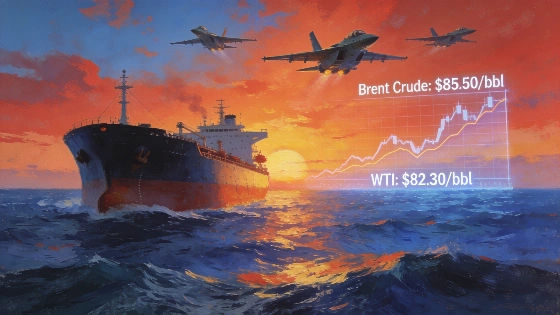
Oil prices soared nearly 6% after the U.S. launched new strikes on Iran. The escalation followed attacks on commercial vessels in the Strait of Hormuz. Washington has now withdrawn a key waiver for Iranian oil sales.
Global oil markets reacted sharply on Wednesday as prices for both Brent and West Texas Intermediate (WTI) crude surged following the United States' decision to end its ceasefire with Iran. The move came after a series of U.S. military strikes in response to attacks on commercial vessels in the Strait of Hormuz, a critical shipping route for global energy supplies.
By early morning trading, WTI futures for August delivery had climbed 5.79% to $74.50 per barrel, while Brent crude for September delivery rose 5.92% to $78.55 per barrel. Although both benchmarks retreated slightly from their session highs, the spike underscored the market's sensitivity to renewed tensions in the region.
The escalation was confirmed during a joint press conference in Ankara, Turkey, where U.S. President Donald Trump stated that, in his view, the ceasefire with Iran was finished. He indicated that further negotiations with Tehran were unlikely, describing talks as unproductive. According to Trump, the U.S. had sought a peace agreement, but he no longer saw value in continued dialogue.
The U.S. military described its actions as a "series of powerful strikes" carried out in retaliation for attacks on three commercial vessels transiting the Strait of Hormuz the previous day. The U.S. Central Command characterized Iran's actions as unwarranted and a clear breach of the ceasefire, warning that Tehran would face significant consequences for targeting commercial shipping.
Last month's ceasefire had temporarily reopened the Strait of Hormuz for commercial traffic after a period of disruption. However, the latest incidents have led to a reassessment of security risks in the area. The U.S.-led Joint Maritime Information Center raised its threat level for ships passing through the strait to "severe," citing the likelihood of further hostile actions by Iran.
In a parallel move, the U.S. Treasury Department revoked a waiver that had allowed Iran to continue selling oil, signaling a tightening of economic pressure. A U.S. official, speaking anonymously to CNBC, emphasized that Iran would only benefit if it demonstrated improved behavior, and described the recent attacks as wholly unacceptable.
Iran's foreign ministry condemned the U.S. strikes, calling them a gross violation of the Memorandum of Understanding reached last month. The ministry reiterated that Iran's armed forces would defend the country's territorial integrity and sovereignty against any military aggression from the United States.
Strategists noted that the timing of the attacks coincided with state funeral ceremonies for Ali Khamenei, and suggested that Iran's leverage in negotiations could increase as the U.S. approaches its midterm elections in November. Rising oil prices and higher yields could also influence the Federal Reserve's stance on inflation, with the 10-year Treasury yield up 5 basis points to 4.581%.
The Strait of Hormuz remains one of the world's most important chokepoints for oil transit, with a significant share of global crude passing through its waters. Disruptions in this region have historically led to volatility in energy markets and can have ripple effects on fuel prices, shipping costs, and broader economic stability. As tensions persist, market participants and governments alike are closely monitoring developments for potential impacts on supply chains and inflation, including in countries like Spain that rely on imported energy.