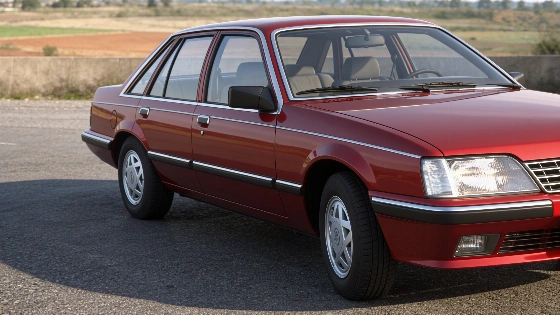
The Opel Senator 3.0i automatic redefined expectations for executive sedans in 1980s Spain. With a powerful six-cylinder engine and advanced transmission, it offered ministerial comfort at a price that undercut its Bavarian competitors.
Spain’s executive car market in the mid-1980s was a closed club. The Opel Senator 3.0i automatic crashed that party. It didn’t just show up as another option. It forced buyers and rivals to take notice. The press called it “el coche de los ministros.” That wasn’t just a nickname. Ministers and diplomats actually drove them.
Opel wanted in on a segment ruled by Mercedes Clase E and BMW Serie 5. In Spain, the badge on the hood mattered as much as the car itself. Most saw Opel as a brand for the practical or the modest. The Senator changed that. Spanish automotive journalists and independent reviews at the time confirmed Opel’s intent: the Senator was a real rival to the top German executive sedans, even if it didn’t carry the same name as the E-Class. It was a peer, not a follower.
The Opel Senator model was first introduced in 1977 and underwent a significant update in 1983, making the 1985 version an evolution rather than an all-new car.
The Senator stood out for more than its size. Under the hood sat a three-liter inline-six with 180 horsepower. The 1985 facelift brought a four-speed automatic gearbox. That was a big step up from the old three-speed. Drivers got better fuel economy and smoother highway cruising. A button on the console let you lock out fourth gear for sharper response. That detail showed Opel was thinking about real-world driving, not just specs. Independent automotive sources confirm this four-speed automatic was new for the 1985 update.
The engine was classic German engineering. Bosch LE-Jetronic injection. 9.4:1 compression. It needed 96-octane fuel. Peak power—180 CV—came at 5,800 rpm. But the real punch arrived above 3,500 rpm. Testers said it felt like a turbo car, even though it wasn’t. The torque figure—25.3 kgm—meant strong pull in the mid-range. That came straight from period technical reviews.
On the road, the Senator’s size faded away. The independent suspension soaked up bumps. Power steering was precise, if a bit slow. The car felt balanced in corners. Push harder, and the rear would step out gently. Skilled drivers could control it. Four ventilated disc brakes gave strong, predictable stops. Inside, the cabin stayed quiet. Road and engine noise barely crept in.
The official price for the Opel Senator 3.0i automatic in Spain was recorded at 4,170,314 pesetas, reflecting its positioning among high-end executive sedans in the mid-1980s market.
The Senator wasn’t perfect. The interior had all the right features—climate control, electric windows, central locking, an onboard computer. But the design felt plain. The dashboard looked like it belonged in a Corsa or Kadett. Even the optional leather seats were slippery. Comfort was good, but the luxury feel was missing.
Space was a mixed bag. The car was long, but the cabin was no wider than a Rekord. That limited the sense of room. The trunk was a different story. It held 440 liters. That beat many rivals.
Direct comparisons were inevitable. The BMW 528i automatic cost a bit more. It had more brand prestige and a slightly smaller trunk. Other contenders—Volvo 760 GLE Intercooler, Rover Vanden Plas—offered their own blend of comfort and performance.
The price? 4,170,314 pesetas. For that, buyers got speed, comfort, and handling that surprised many. The Senator appealed to those who cared more about substance than status. That debate—practicality versus image—still plays out today, as seen in the recent coverage of electric car charging disputes in Spanish apartment blocks. Sometimes, what works matters more than what impresses.
The Senator never fully escaped its mainstream roots. The interior and the Opel badge kept it just outside the top tier. But on the road, it earned respect. The car’s legacy? It challenged the old order. It offered real comfort and performance without the usual price tag. For buyers willing to look past the badge, the Senator still proves that substance can beat status.