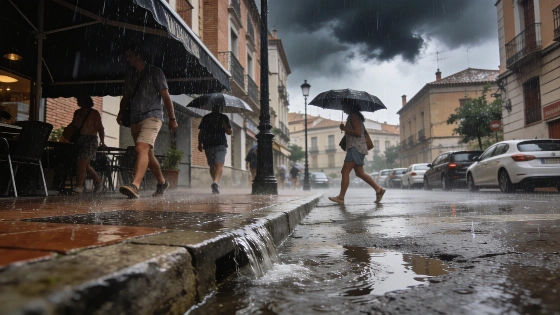
Fifteen autonomous communities are under weather warnings for rain and storms. Five regions move to orange alert. Temperatures drop sharply in the north, while heat and fog persist in some areas.
Spain faces a weekend of severe weather as the State Meteorological Agency (AEMET) has placed 15 autonomous communities under warnings for rain and storms this Saturday. Five of these regions—Aragón, Castilla y León, Cataluña, La Rioja, and Comunidad Valenciana—are now under orange alert, signaling a significant risk of intense rainfall and thunderstorms. The warnings come as a result of an Atlantic trough transitioning into a DANA, creating unstable conditions across much of the peninsula.
Orange alerts for rain and storms specifically affect Teruel; León, Palencia, and Soria; Tarragona; the Ibérica riojana; and Castellón. Additionally, Barcelona and Lleida are under orange alert for heavy rain alone. Other areas with yellow or orange warnings include parts of Andalucía, Castilla-La Mancha, Extremadura, Galicia, Madrid, Murcia, Navarra, País Vasco, and the Balearic Islands. In these regions, authorities expect strong downpours, hail, and gusty winds, especially in mountainous and eastern zones.
Alongside the risk of storms, AEMET has also issued yellow alerts for high temperatures in Córdoba, Mallorca, Girona, and Pontevedra, as well as for coastal waves in Pontevedra and fog in Lugo. The agency forecasts that skies will remain mostly cloudy or overcast, except in the far south, Ceuta, and Melilla. Light rain is expected in the Cantabrian area from early morning, while isolated storms may develop in Ciudad Real and spread to neighboring provinces. As the day progresses, convective clouds will form over much of the peninsula and the Balearic Islands, bringing further showers and storms, particularly inland.
According to AEMET, the most intense storms could bring very strong winds and large hail, with the greatest impact likely in the interior and eastern regions. In the Canary Islands, the north of the higher islands will see cloudy skies and possible light rain, while the rest of the archipelago remains mostly clear. Fog banks are forecast for the far north and Alborán coast, and a light haze may affect the Canary Islands.
Temperatures are set to fall across the peninsula and both archipelagos, with the most pronounced drops—over 6ºC—expected in the northern interior. Only the Rías Baixas in Galicia may see local temperature increases. Despite the general cooling, highs above 35ºC are still possible in the southwest, the Balearic Islands, and occasionally along the Mediterranean coast and Rías Baixas. Nighttime lows will remain above 20ºC in much of the southern half, northeast, Mediterranean coast, and even parts of the Cantabrian region.
Winds will be moderate and northerly in the northern half of the peninsula, potentially strong along the western Galician coast. In the south, winds will come from the south and southwest, ranging from light to moderate, while the Mediterranean and Balearic areas will experience moderate easterly and southeasterly winds. The Canary Islands will see moderate trade winds, with strong gusts possible in exposed areas.
This broad pattern of instability follows a series of recent weather events that have brought both heatwaves and storms to Spain. For context, a recent analysis by russpain.com highlighted similar risks in northern and eastern regions, underscoring the ongoing volatility of the season.
Spain's weather alert system uses color codes to indicate risk levels, with orange representing a significant threat to safety and property. Residents in affected areas are advised to stay informed through official channels and take precautions as conditions evolve. The combination of heavy rain, hail, and sudden temperature changes can disrupt travel, agriculture, and daily routines, especially in regions unaccustomed to such rapid shifts. As the summer progresses, authorities continue to monitor for further episodes of extreme weather, which have become increasingly common in recent years.