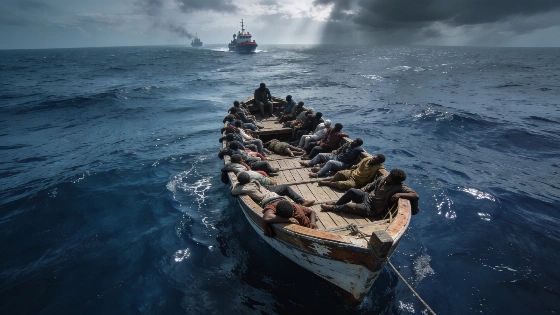
A boat carrying migrants from Gambia to the Canary Islands was found adrift off Mauritania. Only 38 survived, while 143 are missing or dead. The incident highlights the deadly risks of the Atlantic migration route.
Authorities in Mauritania have recovered a migrant boat that left Gambia at the end of June, with only 38 survivors found on board and at least 143 people feared dead or missing. The vessel, which was attempting the perilous journey to the Canary Islands, was discovered adrift near Nouadhibou on July 18, according to the United Nations Refugee Agency (Acnur).
Initial reports from survivors and relatives indicate the boat departed from Bafuloto, a town in Gambia, on June 28 with around 200 people on board. By the time Mauritanian authorities located the cayuco, it was in critical condition—without a functioning engine, almost out of fuel, and lacking GPS equipment. Among those rescued were 34 adult men, two women, and two minors. Most survivors were from Senegal and Gambia, with others from Guinea-Conakry and Côte d'Ivoire. Two of the rescued, including a Senegalese man and a Gambian traveling with family, died shortly after being saved.
The first public alert about the missing boat appeared on social media on July 11. Evidence suggests the vessel suffered a mechanical failure about a week after departure, leaving those on board stranded for over two weeks. As food and water ran out, the number of casualties mounted. Survivors described how, as people died, their bodies were thrown overboard—a grim pattern seen in similar incidents on this route.
Among the survivors, two children lost their entire families and are now recovering in a hospital in Nouadhibou, along with other rescued passengers. The tragedy has sparked calls for urgent action in Gambia, with local activists highlighting the lack of attention given to such disasters compared to other violent incidents in the country.
Acnur has emphasized that, despite ongoing efforts by coastal authorities and humanitarian organizations, the Atlantic route from West Africa to the Canary Islands remains one of the deadliest migration corridors in the world. The combination of long distances, unpredictable ocean conditions, overloaded and fragile boats, and limited rescue capacity continues to result in high mortality rates.
Official figures show that by July 15, around 4,400 people had reached the Canary Islands via irregular maritime routes in 2026—a 61% decrease compared to 2025. This drop is largely attributed to intensified controls in Mauritania and Senegal, which have shifted departure points further south to Gambia and, to a lesser extent, Guinea-Conakry. The increased distance makes the journey even more dangerous for those attempting it.
Within Gambia, traditional departure points such as Jinak, Tandji, Gundjur, and Banjul have been joined by new locations along the Gambia River, as organizers seek to evade coastal patrols. The boat from Bafuloto was one of three intercepted by Mauritanian coastguards in the same week. Another vessel, also from Gambia, was rescued with 169 people on board, while a third was found near Nouadhibou with 179 migrants, mostly from Senegal, as well as Gambia, Ghana, and Mali.
The Atlantic migration route to the Canary Islands has become increasingly hazardous in recent years. The shift in departure points and the use of more remote launch sites reflect both the tightening of controls in some countries and the persistent demand for migration opportunities. The risks faced by migrants on this route are compounded by the lack of safe and legal alternatives, making tragedies like the one off Mauritania a recurring reality.
For context, the Canary Islands have long been a key entry point for migrants from West Africa seeking to reach Europe. The journey, which can take several days in open boats, is fraught with danger due to strong currents, unpredictable weather, and the limited capacity of rescue services. International organizations continue to call for coordinated action to address the root causes of migration and improve safety for those undertaking such journeys.