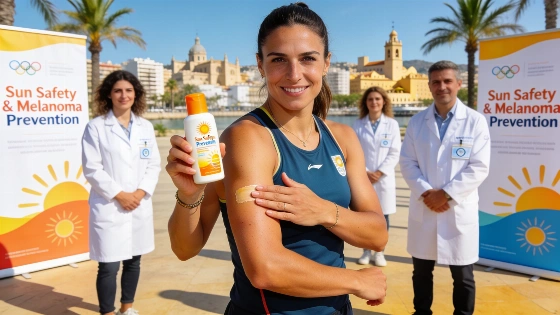
More than 600 new melanoma cases are reported each year in Málaga province, making it a focal point in Spain’s fight against the disease. The high incidence led organizers to choose Málaga as the second stop for the national campaign Objetivo Cero Melanoma 2026, which aims to raise awareness of early detection and skin cancer prevention. Olympic badminton champion Carolina Marín visited the city to support the initiative, stressing the need for consistent sun protection and regular skin self-examinations.
Led by Cantabria Labs and supported by the Fundación de la Academia Española de Dermatología y Venereología (AEDV) and the Asociación Española Contra el Cáncer (AECC), the campaign brings together more than 40 dermatologists nationwide. Under the slogan «Deja a Cero el Melanoma», the Málaga event focused on spotting warning signs early and making skin checks part of routine personal health care. The campaign reflects a growing public-health concern: melanoma incidence is rising in Spain, and ultraviolet radiation remains the basic modifiable risk factor.
One basic message was the ABCDE rule for monitoring moles: asymmetry, irregular borders, uneven color, a diameter greater than approximately six millimeters, and changes over time. The “ugly duckling” sign offers another useful prompt: a mole that looks noticeably different from a person’s other spots merits attention. New or changing lesions, or those that itch, bleed, or crust, should be assessed by a medical professional, not judged using an online or automated screening tool.
Carolina Marín described how her approach to sun safety has changed. Scientific evidence, she said, now makes clear that sun protection should be a daily habit, not something reserved for occasional exposure. She also stressed the value of regular dermatologist visits, which she has made part of her own routine. The American Academy of Dermatology recommends broad-spectrum, water-resistant sunscreen with SPF 30 or higher. Apply it before going outdoors and reapply at least every two hours, as well as after swimming or heavy sweating. Protective clothing and shade offer further barriers to ultraviolet exposure. Tanning beds are best avoided, too.
Leandro Martínez, head of Dermatology at Hospital Regional de Málaga and director of Dermacenter, warned that melanoma can go unnoticed without regular skin checks. Public knowledge about prevention is growing, he said, but that awareness has yet to become a widespread daily habit. Martínez urged people to consult a dermatologist if they notice changes or have concerns about their skin. Prompt clinical assessment matters: melanoma is highly treatable when detected early.
Isabel Orbe, General Director of the AECC, said skin cancer remains one of the most preventable forms of cancer, yet its incidence continues to rise because people pay insufficient attention to sun safety. She called for greater public commitment to prevention. Eva Muñoz Couselo of Science Media Centre España has also pointed to the contrast between the importance of sun protection and rising melanoma incidence in Spain.
Spain’s southern regions, including Málaga, face higher risks because of intense, prolonged sun exposure. Early detection and education are considered impressive as melanoma rates have climbed in recent years. A 2026 review in the International Journal of Pharmacy Practice estimates that about 325,000 new melanoma cases and 57,000 deaths occurred worldwide in 2020. Its projections rise to roughly 510,000 cases and 96,000 deaths by 2040. The review identifies education and behavioural counselling, along with sunscreen, protective clothing and shade-seeking, as prevention approaches. It also discusses community pharmacies as potential channels for public education. Legal and health-related decisions in Spain have featured in other recent news, including the Madrid court’s confirmation of a prison sentence for Toño Sanchís, reflecting a broader trend of public institutions addressing issues affecting citizens.
Melanoma is the most aggressive form of skin cancer, but early detection significantly improves treatment prospects. Dermatologists widely recommend the ABCDE rule as a practical way to monitor changes, while stressing that self-examination does not replace professional assessment. In Spain, prevention campaigns promote routine sun protection, protective clothing, avoiding peak sun hours, and seeking medical advice about suspicious skin changes. The Málaga campaign is part of a broader national effort to reduce melanoma cases and encourage healthier habits across the country.