A new study warns that more than a quarter of olive oil mills in Spain and Portugal could shut down within ten years. Small producers struggle to compete as costs rise and market power concentrates among a few large groups.
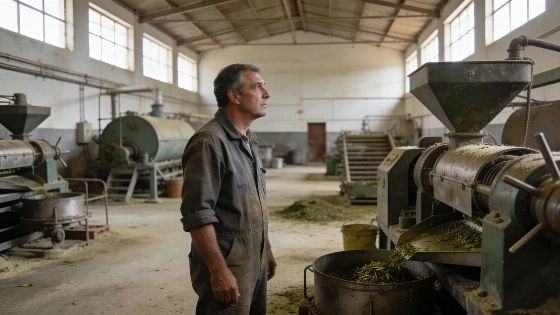
More than 600 olive oil mills across Spain and Portugal are at risk of closing within the next decade, according to a study backed by the Universidad Internacional de Andalucía (UNIA). The research highlights that 27% of the 2,219 existing mills in the Iberian Peninsula may be forced out of business due to mounting competitiveness challenges and declining profitability. The sector is increasingly dominated by a handful of major bottling and distribution groups, leaving smaller mills exposed to market volatility and rising costs.
The study, led by Juan Vilar and Sergio Caño, points to a critical imbalance: while the number of mills remains high, only a few large players control the downstream market. To survive, mills must process at least 1.3 million additional kilos of olives annually to reach economic viability. However, with limited fruit available, competition intensifies, often resulting in what the authors describe as 'sectoral natural selection'—where only the most efficient and largest mills endure.
Organic growth in olive production over the past decade has reached just 15%, far short of the 35% increase needed for mills to break even under current cost structures. The report notes that in Portugal, just eight mills handle nearly half of the country's olive crop, while in Spain, some facilities process up to 60 times the national average. Of the total mills, 1,047 operate as cooperatives, responsible for 40% of production, while 1,172 are industrial mills, accounting for the remaining 60%. The study forecasts that, unless mills consolidate or integrate into larger cooperative groups such as DCOOP, Oleoestepa, Jaéncoop, Interóleo, or MIGASA, 603 mills—472 in Spain and 131 in Portugal—could disappear by 2036.
Cost pressures are mounting across the sector. The latest update from the Asociación Española de Municipios del Olivo (AEMO) reveals that with average olive oil prices at €3.51 per kilo, more than 75% of Spain's olive-growing land is now operating at a loss or on the brink of unviability. This is especially true for traditional and mountain olive groves, where mechanization is limited. Over the past six years, production costs have surged by 57%, with traditional non-mechanized dryland groves facing costs of €5.31 per kilo, and even the most efficient intensive and hedge systems now exceeding €3 per kilo.
Industry leaders argue that the future of traditional olive groves depends on differentiating and adding value to their extra virgin olive oil, ensuring prices at origin that allow farmers to remain profitable. The unique qualities of oil from traditional groves—linked to Mediterranean diet benefits, environmental sustainability, and rural economies—are seen as key to survival. This challenge mirrors broader trends in Spanish agriculture, where small producers face increasing pressure to consolidate or modernize, as seen in other sectors such as housing and mortgages, where market shifts have forced buyers to adapt to new financial realities.
Spain remains the world's largest olive oil producer, with the sector playing a vital role in rural employment and exports. However, the ongoing squeeze on margins and the dominance of large market players may reshape the landscape of olive oil production in the coming years, with significant implications for traditional farming communities and the broader agri-food economy.