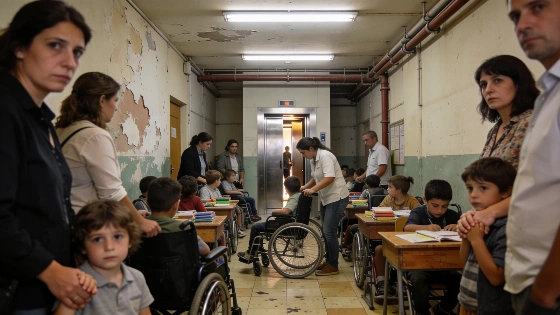
Nearly 270 students attend a special needs school built for 80 in Alcalá de Henares. Families report severe staff shortages and outdated facilities, while authorities insist resources are sufficient.
Families of students at the Pablo Picasso special education school in Alcalá de Henares are raising alarms over chronic overcrowding and a lack of essential staff, as the center now serves almost 270 children—more than triple its original capacity. The school, opened in 1982 for just 80 students, is now stretched to its limits, with makeshift classrooms replacing former communal spaces and only one functioning elevator for 40 wheelchair users. Despite repeated appeals from parents and the Asociación de Madres y Padres de Alumnos (AMPA), regional authorities maintain that the school is adequately resourced.
Parents describe a daily struggle with deteriorating infrastructure and insufficient personnel. Many classrooms suffer from leaks, posing health risks for children with respiratory issues. The long-standing demand for a second elevator remains unresolved after a failed installation left the school without the promised upgrade. Another elevator sits idle due to unresolved permit issues, compounding accessibility challenges for students with severe mobility needs.
Staffing remains a critical concern. While official ratios—one teacher per eight students—are technically met, families argue that the complexity of students' needs requires more specialized support. The AMPA is calling for a therapeutic pedagogue and a social integration technician in every classroom. The school employs four nurses, but one is dedicated full-time to a student with a tracheotomy, leaving the rest overstretched, especially during excursions or emergencies.
Personal stories highlight the impact of these shortages. Parents like Mercedes Camino and Begoña Gómez, both caring for children with rare syndromes, express frustration at the lack of progress over the years. They note that while staff are dedicated, the system leaves them overwhelmed. Other families, such as that of Conchi Yebra, point to the need for smaller class sizes to better manage behavioral and cognitive challenges. Efforts by parents to improve the school environment, including fundraising €7,000 for an accessible playground swing, underscore the gaps left by official support.
Teachers echo these concerns. Carmen Hervás, a therapeutic pedagogy specialist with two decades at the school, recalls when there were fewer than 100 students and ample space for specialized activities. Now, nearly all communal rooms have been converted into classrooms. She notes a rise in students with complex diagnoses, including autism and severe motor disabilities, making individualized attention increasingly difficult.
The local council, which owns the building and handles minor renovations, points to recent investments of €190,000 since 2023 and promises further improvements through the summer. However, the regional Department of Education, Science and Universities has not directly addressed parents' concerns, reiterating only that the school meets all regulatory requirements and that resource allocation is coordinated with school management teams.
The situation at Pablo Picasso reflects broader challenges in Spain's special education sector, where families often face administrative and logistical barriers to accessing adequate support. Similar issues have been reported elsewhere, such as in Catalonia, where authorities have launched initiatives to identify and assist families missing out on social benefits—an effort detailed in a recent report on targeted welfare outreach for vulnerable children.
According to Spain's Ministry of Education, special education centers are required to comply with strict staffing and facility standards, but enforcement and funding levels vary by region. The ongoing situation in Alcalá de Henares highlights the persistent gap between official policy and the lived reality for many families, as demand for specialized support continues to grow.