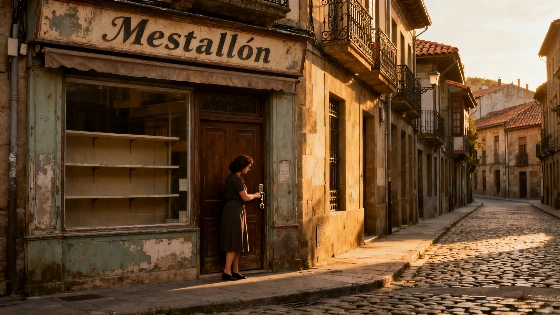
After nearly 54 years in daily life in Oviedo, Perfumería y droguería Mestallón has shut for good. Located on Calle San Pedro Mestallón, the shop was one of the city’s best-known family businesses. Its closure reflects the mounting challenges facing small retailers in Spain.
Inside the nearly empty store, owner Raquel Iglesias faces the end of a chapter that began with her parents, Ramón Iglesias and Ángela Simón, when the neighborhood was still surrounded by fields. For the past three decades, Raquel has managed the counter as the area transformed and the community grew around her family’s shop.
Sales Decline Forces Closure
The decision to close did not come suddenly. Raquel Iglesias says the business had become unsustainable, with sales falling so far that it could no longer continue. “The business no longer supports itself,” she told COPE Asturias, resigned after years of effort. She ruled out taking on debt to keep the shop afloat, arguing that borrowing cannot solve the problem when a business cannot stand on its own.
National indicators offer context for the pressures on local commerce, though they do not measure Mestallón’s individual sales or explain its closure. Spain’s National Statistics Institute reported that commerce production fell 1.9% year on year in August in its seasonally and calendar-adjusted series. Other market services rose 2.4% in the same release. The overall market-services production index increased 0.5%.
September figures on self-employed workers also showed diverging trends across sectors. A report citing social-security affiliation data said Spain gained an average of 474 self-employed workers a day during the month, while commerce lost 763 in total. Asturias recorded a monthly decline of nine self-employed contributors across all sectors. Lorenzo Amor, president of the Spanish Association of Self-Employed Workers (ATA), described commerce as “a sector going through a very difficult situation,” as reported by MuyPymes. These figures track social-security affiliations, not the number of shops closing.
Business registrations paint a mixed regional picture. Asturias recorded 1,295 new companies between January and September 2026, up 11.1% on the same period in 2025, information from Europa Press reporting based on National Statistics Institute data. Company dissolutions in the region fell 0.8%, while the national total rose 9.7%. Those figures cover incorporated companies across sectors. They do not directly measure conditions for neighborhood retailers or self-employed shopkeepers.
For many locals, the closure means more than losing a store. Mestallón was a familiar presence where neighbors exchanged news and advice as they bought products. Its absence leaves a gap in the neighborhood’s daily rhythm.
Personal Toll and Uncertain Future
Raquel’s farewell is marked by deep sadness. She recalls “many years of struggle and long hours” and now faces the uncertainty of self-employment without the safety net of unemployment benefits. Mestallón’s closure ends a business and a family legacy that spanned generations.
The closure also highlights the difficulty of starting over after decades of dedication. For Raquel, launching a new venture feels daunting, especially in a retail field increasingly dominated by large chains and franchises.
Reflection on Urban Change
In her final days behind the counter, Raquel reflected on the changing face of Spanish cities. She urges residents to “change their mindset and return to small, original, and different shops,” warning that city centers are becoming indistinguishable as franchises take over. “Sometimes you don’t know if you’re in Oviedo, La Coruña, or Valladolid,” she says, stressing that small businesses give a city its unique character.
Community and Legacy
As she closed the shutters for the last time, Raquel was moved by support from neighbors and fellow shopkeepers. “Neighborhoods are like family and home,” she said, describing the sense of community that defined Mestallón’s place in Oviedo.
Her parting message is clear: “It’s very impressive to support the businesses right under your home.” Mestallón’s story reflects the fragile balance that keeps local commerce alive and the personal stories behind every shopfront that disappears from Spanish streets.
Talent24h reports that Mestallón’s closure is part of a broader trend affecting small retailers across Spain, as changing consumer habits and the rise of large chains reshape the urban field.