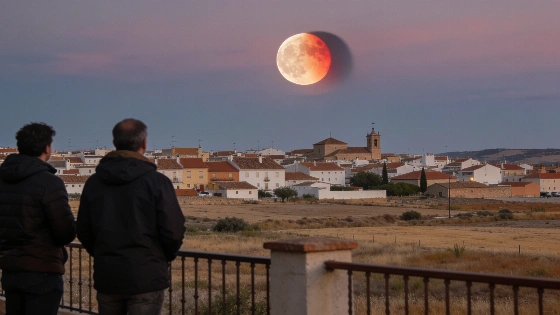
A partial lunar eclipse will be visible across Spain on August 28. The western provinces will see the most complete phase. No special equipment is needed, and the event will be safe to watch with the naked eye.
Spain is set for another major astronomical event this August, as a partial lunar eclipse will be visible nationwide in the early hours of the 28th. The phenomenon will reach its peak at 06:12 (mainland time), with nearly 96% of the Moon's surface covered by Earth's shadow. For residents in the Canary Islands, the timing shifts one hour earlier. The western regions of the country, including Galicia and Extremadura, are expected to have the clearest and most complete view, as the Moon will remain above the horizon for the entire partial phase.
Unlike the total solar eclipse that drew crowds on August 12, this lunar event does not require any protective eyewear. According to the Instituto Geográfico Nacional, the eclipse will be safe to observe with the naked eye. The agency notes that in central and eastern Spain, as well as the Balearic Islands and Melilla, the Moon will set before the partial phase concludes, limiting visibility. In contrast, the west, the Canary Islands, and Ceuta will experience the full duration of the partial eclipse before moonset.
The eclipse occurs as the Earth moves between the Sun and the Moon, casting a shadow that can give the lunar surface a reddish or coppery tint. This effect, while less intense than during a total lunar eclipse, is caused by Earth's atmosphere scattering sunlight—especially red wavelengths—into the shadow. Although this will not be a so-called 'blood moon,' the visual effect may still be striking for observers in the right locations.
To help the public track the event, the Instituto Geográfico Nacional has launched an interactive tool on its website. This resource allows users to check the exact timing of moonset and the eclipse phases for cities across Spain, making it easier to plan observations. The eclipse's magnitude is listed at 0.93, and it will also be visible in parts of western Asia, Europe, Africa, and the Americas, though the experience will vary by region.
Spain's skies have already delivered dramatic weather and celestial events this August. Just weeks ago, severe storms and rare meteotsunamis impacted Catalonia and the Balearic Islands, as reported in coverage of the recent extreme weather. Now, attention turns upward once again for this rare lunar spectacle.
Looking ahead, Spain will host two more significant eclipses in the coming years. On August 2, 2027, a total solar eclipse will cross the peninsula in broad daylight, with the best views expected along the southern coast, especially in Cádiz, Málaga, Granada, Almería, Ceuta, and Melilla. The event is forecast to last at least six minutes. Another notable date is January 26, 2028, when an annular solar eclipse—where the Moon covers the Sun's center, leaving a 'ring of fire'—will sweep from southwest to northeast, passing through major cities including Madrid, Seville, and Valencia, and ending in the Balearic Islands and southern Catalonia. This phenomenon will unfold over roughly two hours, offering unique images across the country.
Lunar eclipses, unlike their solar counterparts, are visible from anywhere on the night side of Earth where the Moon is above the horizon. This makes them accessible to a much wider audience. For those interested in astronomy or simply looking for a memorable night sky event, the partial lunar eclipse on August 28 offers a rare opportunity—especially for those in Spain's western provinces.
For context, lunar eclipses occur when the Sun, Earth, and Moon align, with Earth casting a shadow that can partially or fully obscure the Moon. The reddish hue sometimes seen is due to atmospheric scattering, a phenomenon that also causes sunsets to appear red. While total lunar eclipses are less frequent, partial eclipses like this one still provide a dramatic celestial display. The next total lunar eclipse visible from Spain is not expected for several years, making this August's event particularly noteworthy for skywatchers.