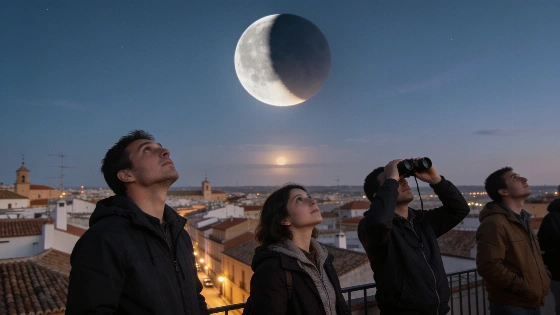
A major partial lunar eclipse will be visible across Spain on August 28. Up to 93% of the Moon will be covered by Earth's shadow. Not all regions will see the full event due to moonset times.
Spain is set for a striking astronomical event in the early hours of August 28, when a partial lunar eclipse will be visible across the country. According to the Observatorio Astronómico Nacional (IGN), nearly 93% of the Moon’s diameter will be covered by the Earth’s shadow at the peak of the eclipse, making it one of the most significant partial eclipses in recent years.
This eclipse comes just over two weeks after the total solar eclipse of August 12, forming a natural pair of celestial phenomena. While the solar eclipse saw the Moon block the Sun from view, this time the Earth will cast its shadow onto the Moon during the full moon phase. The event highlights the precise orbital mechanics of the Sun-Earth-Moon system, with both eclipses resulting from their alignment but observed from opposite perspectives.
The partial lunar eclipse will begin with the penumbral phase at 3:25 a.m. (peninsular time), followed by the partial phase starting at 4:34 a.m. The maximum eclipse is expected at 6:13 a.m., when the Moon will be just 15 degrees above the horizon in Madrid. The partial phase will end at 7:51 a.m., but in many locations, including Madrid, the Moon will set before the eclipse concludes. The total duration of the partial eclipse will be 3 hours and 17 minutes, though visibility will vary depending on location.
Not all regions of Spain will experience the eclipse in full. In central and eastern areas, as well as the Balearic Islands and Melilla, the Moon will dip below the horizon before the partial phase ends. In contrast, much of western Spain, the Canary Islands, and Ceuta will be able to observe the entire progression. The IGN has published detailed timings for each provincial capital, reflecting these regional differences.
For the best view, observers should look towards the west-southwest as the Moon descends. Unlike solar eclipses, no special equipment or protective glasses are needed to watch a lunar eclipse. However, a clear western horizon is essential, as buildings, trees, or hills could block the most dramatic moments. Binoculars or a small telescope can enhance the experience, revealing the gradual advance of the Earth’s shadow and subtle color changes on the lunar surface.
During the eclipse, the Moon may take on reddish or coppery hues in the shadowed areas, a result of sunlight filtering through the Earth’s atmosphere. While a total lunar eclipse produces the well-known “blood moon” effect, this partial eclipse will display these tones only on the portion of the Moon within the shadow. The event serves as a reminder of the connection between the recent solar eclipse and this lunar phenomenon, both governed by the same orbital dynamics.
This lunar eclipse is part of a remarkable sequence of astronomical events in Spain, following the total solar eclipse of August 12, which was the first in a trilogy of solar eclipses expected between 2026 and 2028. The lunar eclipse offers a more accessible spectacle, requiring only an early start and a clear view of the horizon. No travel or special filters are necessary—just a willingness to watch the sky as the Earth’s shadow sweeps across the Moon.
Lunar eclipses occur when the Earth passes directly between the Sun and the Moon, casting a shadow that can be seen from anywhere on the night side of the planet. Unlike solar eclipses, which are visible only along a narrow path, lunar eclipses can be observed from a much wider area. The next total lunar eclipse visible from Spain is not expected until 2029, making this partial eclipse a notable event for skywatchers. For those interested in astronomy, the August 28 eclipse provides a rare opportunity to witness the interplay of celestial bodies without the need for specialized equipment or travel.