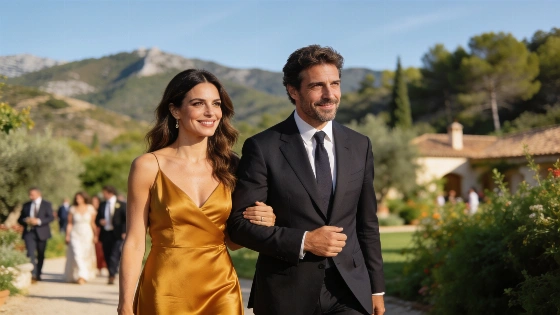
Paula Echevarría made her first public appearance since losing her father, attending a wedding in Madrid with Miguel Torres and her family. The event marks her gradual return after months of mourning.
Paula Echevarría attended her first major public event since her father, Luis Ángel, died. She appeared at a wedding in the Madrid mountains, accompanied by Miguel Torres. After a summer spent grieving, Echevarría chose this occasion to rejoin public life. She wore a mustard satin gown by Rosa Clará, and her calm, more optimistic demeanor stood out as much as her style.
The wedding took place at the Jaral de la Mira estate in El Escorial. For Echevarría, it was more than a social outing—it was a conscious step forward. Surrounded by close friends and family, she was seen sharing affectionate moments with Torres, who has been her main support during this time. Their closeness highlighted how important personal relationships can be after a loss. According to Spanish media, Echevarría's father, Luis Ángel Echevarría Muñiz, died on July 30, 2026, at age 76. The family confirmed the news, which was widely reported in the press.
After her father's funeral, Echevarría spent much of August in Candás, her hometown in Asturias, seeking comfort with her mother Elena Colodrón and her children.
In the months since, Echevarría has spoken openly about her mourning. She spent significant time in Candás, her hometown on the Asturian coast, with her mother and children. There, she reflected on her father's absence and found comfort in familiar routines. On social media, she described how returning home, staying active, and being with her "pack" helped her regain strength. As reported by Hola and 20minutos, Echevarría called this period a time of recovery and leaning on her closest family.
Her 49th birthday came just days after her father's death and became a moment for reflection. Echevarría acknowledged her pain but also thanked her support network—her mother, children, partner, and extended family. She spoke about valuing health and companionship, and her words showed a clear effort to focus on what she still has. On August 30, she publicly congratulated her mother on her birthday, sharing a message about mutual support and the hope to "smile again." This became one of her most notable public statements after her loss, as highlighted by several Spanish outlets.
Family milestones continued to shape her recovery. Echevarría marked her mother's birthday with a heartfelt tribute, wishing her resilience and joy despite their shared grief. These gestures, both public and private, have defined her approach to mourning: not hiding it, but living through it with loved ones.
By the end of August and into early September, Spanish media noted Echevarría's gradual return to professional life, including her appearance among the first guests of the new season of 'El Hormiguero' and her announcement as the lead in the Antena 3 series 'A la deriva,' where she plays Lucía, a character described as strong and ahead of her time.
As autumn neared, Echevarría ended her summer in Candás with a message about returning to Madrid and her usual routines. The wedding of friends Ángel and María became a symbolic end to this chapter. Her enthusiastic social media posts about the event and the joy of celebrating with friends showed a renewed engagement with life. According to Diez Minutos and Antena 3, Miguel Torres has been a steady support, joining her at public events and helping her through this period.
Public figures in Spain often face personal loss under close scrutiny. Echevarría's openness about her grief stands out in a culture where such pain is sometimes kept private. By sharing her journey—from loss to the first steps back to normal life—she offers a rare look at how celebrities handle hardship. This approach is similar to how other Spanish public figures have managed personal loss, as seen in earlier cases of public mourning.
What stands out is Echevarría's resilience, shaped by family, tradition, and her decision to return to public life at her own pace. Her example shows the role of community and ritual in recovery. In a world where the line between public and private is often blurred for celebrities, she sets a measured tone—valuing authenticity and showing that healing, while never complete, is possible with the right support.