Rosa Maria Duran, a central figure for Catalan exiles in Mexico, has died at 99. Her work kept Catalan language and memory alive after the Civil War. She was awarded the Creu de Sant Jordi in 2022.
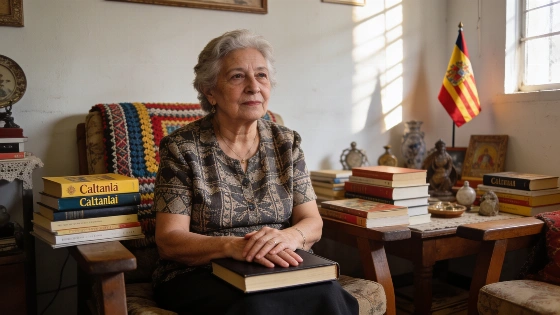
Rosa Maria Duran, a defining figure for Catalan exiles in Mexico, has died at 99. The Centro Nacional de las Artes confirmed her death, closing a chapter for the Catalan community that rebuilt itself far from home. Duran spent her life defending Catalan language and culture, a commitment recognized with the Creu de Sant Jordi in 2022.
Duran's life was shaped by the Spanish Civil War and the upheaval that followed. Born in Barcelona in 1927, she left as a child with her family, first to Montpellier and then, as World War II spread, to Mexico in 1942. She later described arriving in Mexico as survival, not disappearance: Catalan exiles, she said, did not lose themselves—they put down new roots in a country that welcomed them.
Duran dedicated more than 60 years to promoting Catalan language and culture abroad, becoming a key figure for the Catalan community in Mexico.
At a ceremony in Mexico City’s Casa del Risco, Duran summed up her sense of belonging with a phrase that resonated for many: “Our roots are in Catalonia, but our fruits are in Mexico.” Her words spoke to thousands who rebuilt their lives after war and dictatorship, determined to keep their culture alive despite distance and time.
Duran was recognized by both cultural and political leaders. Salvador Illa, president of the Generalitat, publicly mourned her and recalled meeting her in Mexico last November. He spoke of being moved by her story of exile, her commitment to memory, and her work connecting Catalonia and Mexico. Illa said Duran’s efforts were not just about nostalgia, but about building bridges and keeping the story of exile part of Catalonia’s living heritage. According to El Mundo, Illa called Duran a leading figure in the Catalan exile community and stressed her role in preserving historical memory.
Duran studied Hispanic Letters at the Universidad Nacional Autónoma de México (UNAM) and later did postgraduate work at the Sorbonne in Paris. She worked as an interpreter at the United Nations, but her most lasting impact was her advocacy for Catalan identity abroad. Her work echoed the efforts of others trying to recover the memory of Spain’s exiles and victims of repression, as seen in recent investigations into the legacy of Francoist violence.
In 2022, Duran was awarded the Creu de Sant Jordi, one of the highest honors granted by the Generalitat of Catalonia, recognizing her decades-long commitment to Catalan culture in exile. Her academic journey included studies at UNAM and postgraduate work at the Sorbonne, and she also worked as a translator at the United Nations.
For Catalans in Mexico, Duran’s death is more than the loss of a respected teacher and writer. It is a reminder of how fragile memory can be, and how much depends on those who keep it alive. Her belief that “cultures do not cancel each other, they add to one another” remains a guide for new generations facing questions of identity and belonging. In a time when historical memory is often overlooked, Duran’s life shows that exile can be a source of strength. Her absence leaves a gap, but her example remains—a challenge to forgetfulness and a call to remember the stories that shape us.