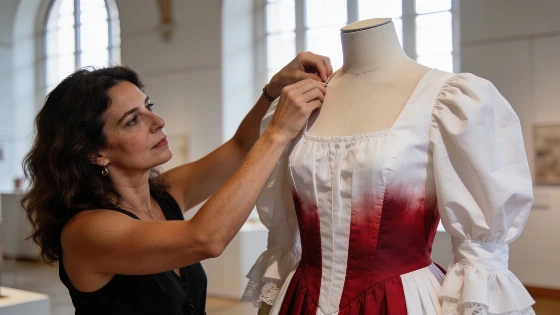
Spain's Ministry of Culture has awarded Pilar Albarracín the 2026 National Visual Arts Award. The €30,000 prize recognises a career built around gender, folklore and cultural power.
On 29 September 2026, Spain's Ministry of Culture announced Pilar Albarracín as the winner of the 2026 Premio Nacional de Artes Plásticas. The award carries €30,000. It also recognises an artist whose performances, photographs, videos and installations question the images used to define "lo español".
Albarracín starts with familiar symbols. Then she pushes them into uncomfortable territory. Flamenco, religious traditions, rural life, gender roles and national folklore become ways to ask who gets represented, who is shut out and who controls the story.
That is her method.
Pilar Albarracín was born in Seville in 1968, according to independent reports by EFE and El País.
Her body is often the main tool. In Lunares, she appears in a white sevillanas dress. The dress slowly turns red as she pins it with needles. A familiar folkloric image becomes a picture of pressure and violence hidden behind a decorative national stereotype.
Several other well-known works use the same approach. In Viva España, Albarracín crossed Madrid as a band pursued her while playing that song. Bailaré sobre tu tumba turned the struggle between the sexes into a four-foot choreography.
The surface looks theatrical and easy to read. The subjects are not. Her work takes aim at inherited customs, social exclusion and the forces that make some identities look normal.
The target is serious.
Albarracín also puts herself inside subjects that are rarely harmless. Her work has addressed gender violence, the harshness of life in some rural settings, urban supremacist attitudes towards the countryside and flamenco, and the picturesque image of Spain that survives in some foreign perspectives.
Irony lets her enter those stereotypes from within. She does not examine them from a safe distance.
In addition to the €30,000 cash prize, the award includes an individual exhibition at the Museo Reina Sofía, according to EFE.
That public dimension connects with the civic concerns visible in Madrid's housing protest, where public space also became a stage for a social claim. Albarracín's art works through performance and symbolism instead of a campaign or institutional programme.
The jury had two chairs: Ángeles Albert, director general of Cultural Heritage and Fine Arts, and Jesús Carrillo, deputy director general of Visual Arts and Contemporary Creation. Its members included Armengol Jiménez, Semíramis González Fernández, Gilberto González, Teresa Grandas, María López-Fanjul, Pedro de Llano Neira and Elena Jiménez Moreno.
The jury praised Albarracín for building one of the most singular and recognisable careers in contemporary Spanish art. The Ministry of Culture called her practice an "updated" approach to Spain's cultural codes. It said she uses irony, theatricality and social criticism to address questions of identity.
The list of previous recipients includes Fina Miralles, Teresa Lanceta, Rogelio López Cuenca, Dora García, José María Yturralde, Àngels Ribé, Ángel Bados, Ángela de la Cruz and Juan Hidalgo.
Todo Alicante reported that Albarracín succeeds Fina Miralles, the previous winner of the award. The new prize gives institutional weight to an artistic language that rejects solemnity without giving up its political commitment.
Albarracín makes tradition visible, then strips away its layer of nostalgia. She uses humour, but does not treat violence or exclusion as a joke. The 2026 award recognises more than a distinctive style. It backs art that breaks open cultural clichés and shows the power inside them.
Coverage by EFE and El País also places the award within wider debates about Spain's international artistic profile and the ways the country represents itself through art.