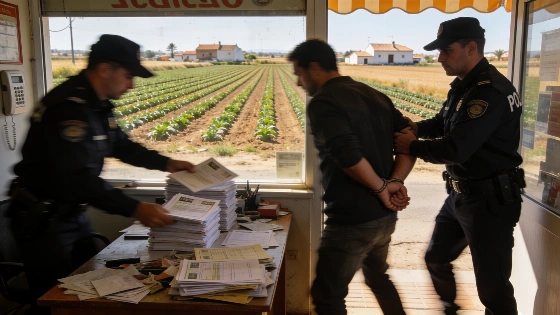
A major police operation in Orihuela has led to 60 arrests for document forgery. Migrant workers used fake papers to secure agricultural jobs. Authorities suspect company managers and locutorio staff were involved.
Spanish police have broken up a large-scale forgery ring in Orihuela (Alicante), arresting 60 people accused of producing and distributing fake documents that allowed irregular migrants to work in the agricultural sector. The operation, which remains ongoing, has exposed how fraudulent paperwork was used to bypass legal requirements for employment in Spain, according to the National Police.
The investigation began in late 2025, when officers from the Extranjería y Fronteras unit in Orihuela received reports of suspicious asylum application receipts being submitted by foreign workers. These documents, which are a prerequisite for registering with Social Security, were primarily presented by Colombian nationals seeking seasonal jobs in agriculture across southern Alicante and the Murcia region.
Police traced the source of the forgeries to a locutorio in central Orihuela, where fake papers were being issued. Two employees of the establishment, including the manager, were detained after a search of the premises. Investigators also identified several agricultural companies that knowingly accepted workers with these fraudulent documents. In one case, officers found 12 employees at a single company using forged paperwork, leading to the arrest of both the workers and the company administrator, who is suspected of being aware of the irregularities.
The methods used by the network varied. In many instances, the date on asylum application receipts was altered to extend the apparent legal stay of the worker, making it easier to obtain work authorization and residency. In other cases, original documents belonging to migrants who had legally processed their status but later left Spain were reused, with only the photograph swapped to match a new worker assuming the identity of a compatriot.
After shutting down the initial source of fake documents, police received further intelligence about another agricultural company employing numerous Colombian workers with fraudulent papers. Four of these workers were arrested for alleged document forgery and identity theft, along with the company’s sole administrator, who is believed to have personally falsified the documents for his employees. A third company, considered a victim of the scheme, was also investigated after a significant portion of its workforce was found to lack proper documentation.
The total number of arrests in the operation has now reached 60, encompassing migrant workers, company managers, and staff from the locutorio. The police have not ruled out additional detentions as the investigation continues. This case highlights ongoing challenges in Spain’s agricultural labor market, where demand for seasonal workers often intersects with complex migration and documentation issues. Similar concerns about the treatment and legal status of workers have surfaced in other sectors, as seen in recent legal proceedings over pandemic-era policies affecting police and civil guards, detailed in this report on vaccination delays for law enforcement in Catalonia.
Spain’s agricultural sector relies heavily on migrant labor, particularly during peak harvest periods. The use of forged documents not only undermines legal employment channels but also exposes workers to exploitation and legal risks. Authorities continue to monitor companies and intermediaries suspected of facilitating irregular employment, emphasizing the need for stricter controls and verification processes. The outcome of this investigation may prompt further scrutiny of hiring practices and document checks in the region’s key industries.