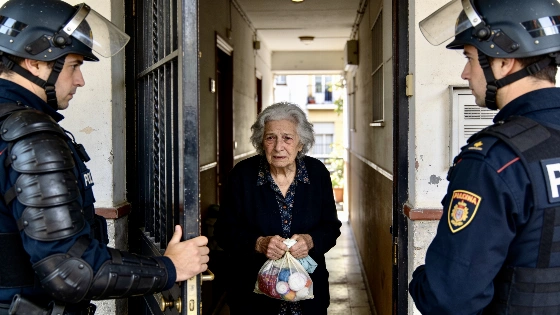
Police broke down the door of a Madrid apartment this week to evict Maricarmen, an 87-year-old woman with a 50% disability who had lived there for more than seventy years. The eviction took place in the Retiro district, where activists and neighbors staged a sit-in to block the entrance. Riot police used anti-riot gear and gas to clear them out. Authorities proceeded despite Maricarmen’s illness and the distress of people trying to protect her.
Dozens gathered outside her home as police cordoned off the area during the eviction, EFE and Infobae reported. Inside, the mood was tense. Activists held onto the entryway, shouting “Maricarmen stays” and “This lady could be your grandmother.” Police cleared the area step by step. Maricarmen, reportedly in poor health, had to pack her things quickly as social services entered. The press was ordered out before the final removal.
The legal fight over Maricarmen’s home goes back to a 1956 rental contract signed by her father. It later passed to her mother, then to Maricarmen, under Spain’s “renta antigua” system. She paid rent tied to inflation for decades. Things changed in 2018, when Urbagestión bought the building and tried to raise her rent by 275%. This led to a series of court cases. Maricarmen won in lower courts, but the Supreme Court sided with the investor, clearing the way for this fourth and final eviction attempt.
After Urbagestión acquired the building, it demanded an increase in Maricarmen’s rent from approximately 500 euros to between 1,650 and 2,650 euros per month, information from various sources. Democrata reported that the company, founded in 2005, specializes in real estate investment and asset management in Madrid.
Every effort to delay or stop the eviction failed. Maricarmen’s lawyer, Beatriz Duro, said the owner rejected all proposals for a delay and would not even give her a few extra hours to collect her things. Instead, she was told her belongings would be sent to an address she chose after the eviction.
The Sindicato de Inquilinas, which backed Maricarmen throughout, accused authorities of ignoring repeated proposals for a public purchase of the flat or new laws to protect vulnerable tenants. The group said no government, from Madrid City Council to the regional and basic levels, offered a real housing alternative. The only option was a place in a private residence costing over 1,200 euros a month, far more than Maricarmen’s pension.
Even international attention did not stop the eviction. The United Nations called on Spain to prevent it and guarantee decent housing. The Ministry of Housing and Urban Agenda urged local and regional authorities to step in. The ministry blamed the city council for failing to act on Maricarmen’s vulnerability and also criticized the regional government for not offering a rent supplement or other housing.
City officials said social services had followed Maricarmen’s case and offered her different types of municipal support, including home help and other places to live. They said she turned these down because she wanted to stay in her home. The city also said it sent a vulnerability report to the court in October 2025, pushing back against the ministry’s claims of inaction.
Scenes like this are now common in Spain’s housing crisis. As reported earlier, authorities have also cleared informal settlements with little warning, leaving people scrambling for shelter. Maricarmen’s case highlights the clash between property rights and the reality for aging tenants with nowhere else to go.
The episode exposes how institutions stall and shift blame. While officials argue and activists try to help, people like Maricarmen face the full force of the law. Riot police evicting an elderly woman after seventy years in her home is a legal story with consequences beyond the courtroom. It shows how much Spain’s housing protections have faded for those least able to fight back.