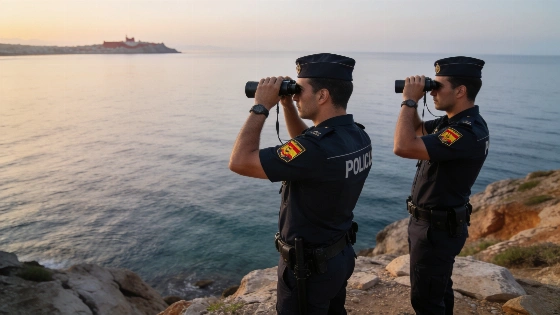
Spanish police have identified a sharp rise in attempted swim crossings from Morocco to Ceuta. Reports suggest Moroccan border controls are relaxed during national holidays, raising concerns of political pressure on Spain and the EU.
Spanish police have raised concerns about a pattern of migration pressure at the Ceuta border, noting a sharp increase in attempted swim crossings from Morocco during major national holidays. This warning follows a documented rise in unauthorized entries that coincided with the Día del Trono, Morocco’s main royal celebration.
According to internal reports from the Centro Nacional de Inmigración y Fronteras (CENIF), police flagged a "very high risk" of mass swim attempts on July 28, just as Morocco prepared for the king’s annual address. Spanish officials linked this spike in crossings to a "temporary relaxation" of Moroccan border controls, suggesting the timing was intentional and meant to highlight Spain and the EU’s reliance on Rabat’s cooperation to manage migration.
A 55-page police report analyzed not only direct observations but also videos, photos, social media posts, migrant interviews, and mobile phone data to document the July 2026 Ceuta border episode.
Evidence collected by CENIF and the Centro de Inteligencia de las Fuerzas Armadas (CIFAS) points to a clear operational pattern. Between July 1 and July 28, Spanish authorities recorded 921 unauthorized crossings and 119 rescues in national waters. Police identified swim attempts as the main risk along the Ceuta frontier, with a sharp increase compared to previous years. The situation was classified as a "consolidated and priority threat."
CENIF’s analysis also noted that Moroccan gendarmes have eased enforcement during periods of political tension in the past, using migration as leverage. The July reports highlighted the Día del Trono, but also identified three other high-risk dates: the National Day for Moroccans Abroad (August 10), the Day of Loyalty (August 14), and the Day of the People’s Revolution (August 20). Spanish police consider each of these dates to carry a higher risk of mass swim crossings or, less commonly, coordinated fence jumps—both seen as "extreme risk" scenarios.
On July 30, the Guardia Civil and Spanish Armed Forces formally accused Moroccan authorities of "passivity" during the migration surge. A classified CIFAS report stated that while Morocco may not be actively encouraging crossings, its security forces acted negligently and did not intervene. Spanish officials said they hoped Moroccan cooperation would resume after the royal festivities ended.
According to Reuters, the Spanish police report prepared for the investigating court described Moroccan security forces' behavior as 'total permissiveness,' meaning there was a factual absence of attempts to disperse or push back the crowd at the Ceuta perimeter. However, Spanish Prime Minister Pedro Sánchez publicly stated there is no evidence Morocco orchestrated the border surge, highlighting the ongoing debate within Spanish institutions.
This approach to border management has drawn more scrutiny in Spain as migration remains a politically charged issue. While using migration as diplomatic leverage is not new, Spanish police have now identified the tactic directly in official reports. As reported earlier, the political stakes around Ceuta have already led to calls for tougher security measures and even military intervention.
Spain’s dependence on Moroccan cooperation for border control is longstanding, but the latest reports show how fragile this arrangement can be. The July 2025 data illustrates how quickly the situation can change when political interests shift. With over 900 crossings in less than a month and clear signs of relaxed border enforcement, Spanish authorities see migration pressure being used as a bargaining tool. This not only tests Spain’s border security but also exposes the EU’s vulnerability to outside actors who understand the influence migration can have. The Spanish government now faces the challenge of responding to these tactics without escalating diplomatic tensions or weakening its own border controls.