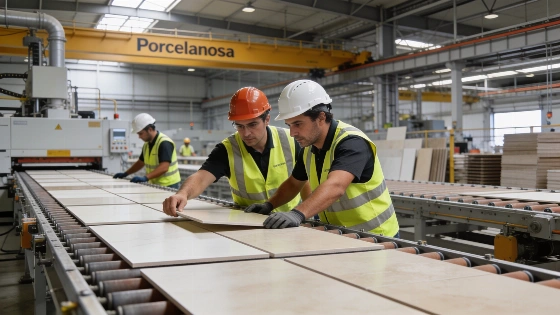
Porcelanosa closed 2025 with €863 million in sales, steady profits, and a sharp rise in industrial investment. The group faced US market setbacks but saw strong growth in Iberia and industrialized construction.
Porcelanosa, the Castellón-based ceramics group, ended 2025 with €863 million in consolidated sales, maintaining its financial strength despite a turbulent international environment and currency headwinds. The company’s annual results show a near-identical turnover to the previous year, with only a marginal 0.5% dip attributed to exchange rate effects. Excluding currency impact, gross sales would have grown by 1% year-on-year. The group’s EBITDA again surpassed €100 million, while pre-tax profit edged up 1.36% to over €28 million. Porcelanosa also reported a guarantee ratio of 2.98 and a total tax contribution of €85 million to public administrations in 2025.
Instead of retreating in the face of global uncertainty, Porcelanosa accelerated its reinvestment strategy. The group allocated €102 million to industrial upgrades and commercial expansion last year, marking an 18.6% increase over 2024. Of this, €71.4 million went directly to production facilities in Vila-real, focusing on expanding large-format porcelain manufacturing and launching the UNDORA® mineral surface line through its Krion subsidiary. The remaining €30.6 million supported the expansion and improvement of the commercial network, with notable real estate investments in Santiago de Chile, Mexico City, and Lagos (Portugal). The company also advanced its digital transformation, integrating artificial intelligence tools to optimize manufacturing and sales processes. In a move to reinforce long-term stability, Porcelanosa completed the buyback of 1,836,837 shares from a minority shareholder during 2025.
International sales remained the backbone of Porcelanosa’s business, accounting for 70.05% of consolidated revenue, while the Spanish market contributed 29.95%. However, regional performance varied sharply. The US market posed the biggest challenge, with sales dropping over 10% due to tariff policy uncertainty in early 2025, which led to delays and cancellations in real estate projects. The company notes that the first half of 2026 shows signs of recovery, with US sales up 8% compared to the previous year. European markets offset the North American slowdown, with total sales in Europe rising 3.78% and countries in commercial expansion posting a combined 10% increase. The Iberian market was particularly robust: sales grew 8% in Spain and 12% in Portugal. Latin America also delivered strong results, with newer markets boosting revenue by 13%. In Asia and Africa, Porcelanosa expanded its physical presence by opening new outlets in Shanghai, Manila, and Abidjan.
By business segment, ceramics remained Porcelanosa’s core, generating 56% of consolidated sales. Yet the fastest growth came from industrialized construction and new sales channels. The Porcelanosa Offsite division, specializing in modular building, saw sales jump 12% year-on-year. Large project channels—including residential, commercial, and hotel developments—grew 16% and now represent 20% of total group revenue. Online sales also surged by 20% in the last year. Despite these shifts, the company’s network of over 200 own-brand stores worldwide remains central, contributing 32% of total income, or €278 million. External distribution channels followed, with a 3% increase in business volume.
Porcelanosa’s results highlight the resilience of Spain’s ceramics sector in the face of global volatility. The group’s strategy of reinvestment and diversification has helped offset regional setbacks, particularly in the US, and underlines the growing importance of industrialized construction and digital transformation. For context, the challenges of international business and oversight have also been a focus in other sectors, as seen in recent investigations into public aid management in Catalonia, detailed in this report on unchecked payments for youth support. Porcelanosa’s experience in 2025 reflects broader trends in Spanish industry: balancing export ambitions with domestic growth, adapting to shifting global conditions, and investing in innovation to secure long-term stability.