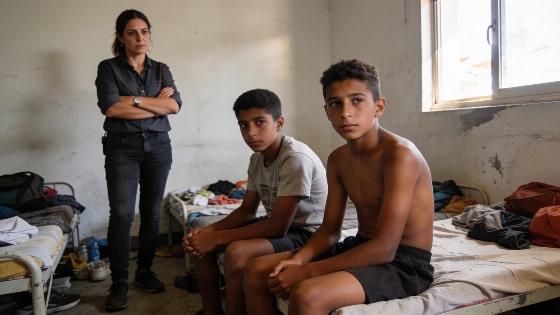
The PP has firmly rejected moving unaccompanied minors from Ceuta to the mainland. This stance, now aligned with Vox, leaves the government with limited options to ease the crisis in the city.
Spain’s government has run into a dead end trying to ease overcrowding in Ceuta’s migrant shelters. The Partido Popular (PP) leadership has flatly refused to let any unaccompanied minors be moved to the mainland, even for a short time. This position now matches Vox’s, leaving nearly a thousand minors stuck in Ceuta and putting the government’s €90 million relocation plan on hold.
The situation worsened after the Audiencia Nacional issued a precautionary order on September 16, 2026, blocking the use of Ceuta’s port as a shelter. Authorities had been preparing to move almost 800 people from the beaches into a modular camp with space for over 800, but the court’s decision stopped all work. The Ministry of Transport can’t continue until a police union’s complaint about the site is resolved, according to EFE and La Voz de Galicia.
As of mid-September, around 2,100 unaccompanied minors remained in Ceuta, with the government beginning to process their individual cases.
PP leaders argue that moving even one minor would encourage more mass entries into Ceuta. Instead, they want Madrid to send more resources to speed up all return procedures, including those for minors. Vox remains firmly against any transfers, and the PP has now voted with Vox in Congress to block the relocation of children and teenagers who arrived during the mass entry at the end of July. On September 16, Congress rejected Vox’s proposal to return all minors to Morocco, with the PP supporting the measure. El Constitucional reports this as a sign of the PP’s increasingly hardline stance.
Until now, Ceuta had cooperated with transfers. In 2025, 700 minors were sent to the mainland. That has changed. The only recent exception was the transfer of five minors to Navarra, under a special agreement with the Socialist-led government there. The government says repatriation is slow, and without transfers, the humanitarian situation in Ceuta will get worse. The Ministry of Infancia, led by Sira Rego, says temporary relocation is the only way to relieve pressure on the city, but nothing can happen without Ceuta’s approval. Europa Press reports the ministry has proposed urgently moving 500 girls to specialized organizations on the mainland, with Ceuta keeping legal guardianship.
On September 13, Audiencia Nacional judge María Tardón requested government documentation regarding the mass entry into Ceuta since July 1, indicating that judicial scrutiny of the crisis was already underway before the latest suspension of the port camp project.
Moncloa.com
The PP points to the European Pact on Migration and Asylum as a possible way to speed up returns, especially if migration is used by other countries to destabilize Spain. But using this clause would require proof that Morocco organized the mass entry to destabilize Spain, which has not been shown. Even then, the pact protects basic asylum rights and requires special safeguards for minors, including appointing a representative during repatriation. The government says delays in processing are partly due to trouble hiring these child advocates in agreement with Ceuta.
Prime Minister Pedro Sánchez has publicly criticized Vivas, who was once praised for his cooperation but is now accused of prolonging a crisis that hurts Ceuta’s residents. The PP says Vivas is defending the city and that any transfer would only make the problem bigger. Vivas has said Ceuta is responsible for caring for minors, but the central government also shares responsibility for their registration and handover. He has called Sánchez’s approach “unprecedented” and described the city’s “titanic effort” in caring for 2,000 unaccompanied minors, blaming the situation on a breach of Spain’s territorial integrity.
The government still hopes Vivas will eventually allow some transfers. If not, ministers warn that Ceuta’s population will bear the cost, as thousands of migrants—many of them children—remain in difficult conditions. Ángel Víctor Torres, who leads the government’s single command in Ceuta, has called on all autonomous communities to accept minors as soon as their cases are ready, appealing for a response “in line with the humanitarian drama.”
The Ministry of Infancia notes that the law is the same in Ceuta as in the rest of Spain, and that nearly €90 million has already been allocated to support the city. The proposal to move 500 girls, considered the most vulnerable group, to specialized care on the mainland is still waiting for Vivas’s signature. The ministry says every day without transfers is due to political unwillingness, accusing the PP of blocking the only workable solution while demanding a return to normality in Ceuta.
This standoff shows the limits of Spain’s migration management when regional and national authorities are at odds, especially with court decisions narrowing the government’s options. Ceuta’s residents and hundreds of minors are left in the middle, as political and legal barriers block any progress. The crisis continues, with no clear solution in sight and vulnerable children stuck in uncertainty.