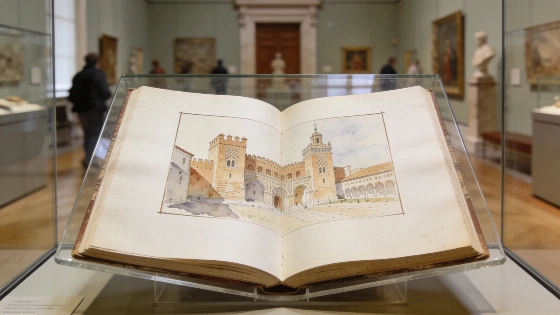
The Prado’s first exhibition devoted to Ricardo de Madrazo brings together 29 sketchbooks spanning 1867 to 1917. The show follows his travels and his work as a copyist, while documenting his place in the Madrazo family.
When the exhibition opened on October 13, 2026, the Prado gave Room 60 of the Villanueva building to an artist long eclipsed by Mariano Fortuny and his brother Raimundo. Ricardo de Madrazo (1852-1917). Dibujos y acuarelas is the museum’s first exhibition devoted specifically to Madrazo. It runs through January 17, 2027, as part of the Prado’s Almacén abierto programme. Launched in 2009, the programme brings lesser-known artists and works from the 19th-century collection before the public. Curator Pedro José Martínez has described Madrazo as an artist who remained in the shadow of better-known relatives and Fortuny.
The exhibition contains 37 works. Most have never been shown publicly; only two were exhibited before. At its centre are 29 sketchbooks, dated from 1867 to 1917 and spanning nearly the whole of Madrazo’s working life. The Prado assembled them over about 20 years in collaboration with the artist’s heirs. It is the museum’s second-largest collection of sketchbooks by one artist, behind Martín Rico’s 40 albums. The Prado also holds more than 50 of Madrazo’s drawings and watercolours. Its collection includes seven paintings, but only one appears in the show: his earliest known self-portrait, dating to around 1880.
The sketchbooks record a life shaped by travel and artistic ties.
Preparatory studies sit beside copies of old masters. Other pages capture landscapes and city views. Madrazo also drew studio models and scenes from family life. The books follow him through Madrid and Rome. Naples appears in the pages, as does Granada. Later entries record Toledo and Venice. He also travelled to Tangier and Fez, then to Biarritz and Lequeitio. Taken together, the locations chart journeys through Spain and Italy, as well as North Africa and France’s Atlantic coast.
Some of the most vivid pages came from southern Spain. Watercolours of Córdoba and Granada catch Islamic architecture. Other studies focus on landscape and the changing light. Among them are Mihrab de la Mezquita de Córdoba and Sala de los Abencerrajes. A separate work, Árboles en la Cuesta del Rey Chico, records trees on the slope. Madrazo’s 1877 journey to North Africa brought Tangier and Fez into his sketchbooks. Some of those studies later informed other compositions; others appeared in illustrated magazines.
Madrazo came from a prominent artistic family. His father was Federico de Madrazo, and his brother was Raimundo. His connection to Fortuny was familial as well as professional. Madrazo worked with models also used by the painter, and recorded Fortuny’s surroundings during stays in Granada from 1870 to 1872. He did the same in Portici in 1874. One drawing, Detalle del interior del estudio de Mariano Fortuny, documents the Rome studio after Fortuny’s death in 1874. It shows the arrangement of the space and objects from Fortuny’s collection before the posthumous sales.
Madrazo also built a career interpreting other painters’ work. From the late 19th century, he made watercolour copies of paintings at the Prado. His copy of Velázquez’s El bufón llamado don Juan de Austria, made around 1901, shows the technical command he had developed by then.
Four partial copies of the ceiling in the Throne Room of Madrid’s Royal Palace show Madrazo working through Giambattista Tiepolo’s complex composition. They also capture his handling of colour. His sketchbooks include studies after Velázquez and Goya. Other pages draw on El Greco. A TVE anniversary feature has likewise used a personal record to revisit a less prominent part of Spain’s cultural history.
Madrazo’s drawings also record daily life. He depicted relatives and animals, along with household objects and places where he lived. He safeguarded a substantial part of the Madrazo family archive, which he inherited from his father, and kept it intact. The exhibition includes a diary dated 1894. It also has a letter he sent his father from Toledo around 1875. The Prado’s acquisitions from the artist’s heirs brought together sketchbooks and documents. The holdings also include works from a legacy that had remained dispersed. The 37-work display presents Madrazo as an independent draughtsman and watercolourist, as well as a member of the Fortuny circle. The Prado acquired material from the artist’s heirs between 2006 and 2026.