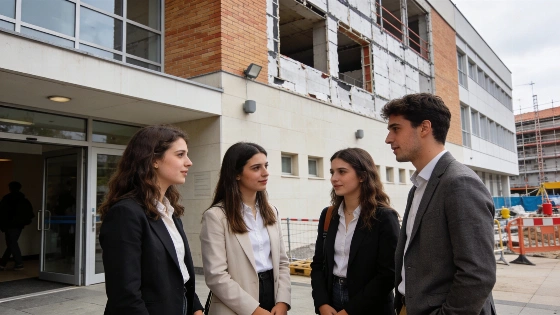
The Generalitat has authorized a private Medicine degree at CEU Elche. This move follows legal battles over public university programs. Up to 55 new students will join, intensifying competition in Alicante.
The Generalitat has granted the Universidad CEU Cardenal Herrera (CEU) permission to launch a private Medicine degree at its Elche campus, marking a significant shift in the province’s higher education landscape. This decision allows CEU to bypass the lengthy legal disputes that previously embroiled public institutions, notably the University of Alicante (UA), which faced court challenges from the Universidad Miguel Hernández de Elche (UMH) over its own Medicine program.
With CEU’s entry, Alicante province now hosts three universities offering Medicine. The approval comes just two years after CEU publicly stated it had no plans to add Medicine to its curriculum. The university will leverage existing accreditations from its Valencia and Castellón campuses, enabling it to open a new group in Elche without starting the authorization process from scratch. The first cohort will be capped at 55 students, who will begin their studies at the Capitolio and Reyes Católicos sites in Elche.
CEU’s expansion is framed as an extension of its already approved Medicine degree, not the creation of a new official title. The university highlights its access to experienced faculty with international backgrounds and plans to establish an Advanced Simulation Center for medical training. According to CEU’s rector, Higinio Marín, the initiative aims to address broader societal needs through both teaching and research.
The shortage of medical professionals across Spain has been a recurring justification for expanding Medicine programs. When UA revived its Medicine degree in 2022, it cited the national deficit of doctors, a problem made more visible during the pandemic. The history of Medicine education in Alicante is marked by rivalry: in 1997, the UMH was established with the Medicine degree transferred from UA, leaving UMH as the sole provider in the province for 25 years.
Recent years have seen renewed competition. The UA secured all necessary accreditations and, despite legal resistance from UMH and support from then-regional leaders Carlos Mazón and Juan Antonio Rovira, ultimately prevailed in court. The Supreme Court confirmed UA’s right to offer Medicine, leading to an agreement between UA and UMH to share hospital facilities for student placements. The first UA cohort is now entering its fourth year, while CEU prepares to welcome its inaugural class in Elche.
Admission to Medicine remains highly competitive in Alicante, with entry grades expected to stay above 13 or 14 out of 14. The addition of CEU’s program is likely to intensify demand and further complicate the landscape for prospective students. The rapid approval of a private degree, contrasted with the protracted disputes between public universities, has fueled debate about the Generalitat’s approach to higher education policy in the region.
This development echoes broader concerns about educational inequality and access, as highlighted in recent coverage of regional education challenges. For example, ongoing issues with graduation rates and funding disparities in Catalonia have drawn attention to the impact of policy decisions on student opportunities, as discussed in a recent analysis of Catalonia’s education system.
In summary, the swift authorization of CEU’s private Medicine degree in Elche underscores both the evolving dynamics of university competition in Alicante and the persistent challenges facing Spain’s medical education sector. The move is set to reshape options for aspiring doctors in the region, while raising questions about the balance between public and private provision in higher education.