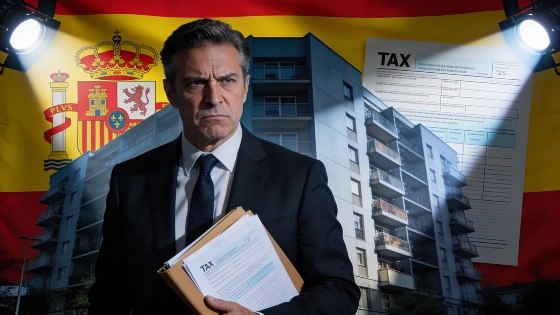
Pascual Ariño, a real estate investor with 16 properties, has publicly criticized Spain's tax system for self-employed workers earning modest incomes. On 'laSexta Xplica', he argued that high taxes and social security costs are driving professionals abroad and fueling the underground economy.
Pascual Ariño, introduced as a real estate investor and owner of 16 apartments, brought the issue of Spain's tax pressure on the self-employed to national attention during a recent broadcast of ‘laSexta Xplica’. Speaking in October 2025, Ariño argued that freelancers earning between €1,000 and €1,500 a month face a combination of taxes, social security contributions, and administrative expenses that leave them with little to show for their work.
He described how, before appearing on the program, he surveyed his followers and found overwhelming agreement that taxpayers are overburdened and that public funds are not being managed effectively. Ariño specifically highlighted the challenges for those with modest monthly incomes, who must navigate VAT, personal income tax (IRPF), mandatory social security payments, and the cost of hiring an accountant just to comply with regulations.
According to Ariño, this environment is pushing many to operate in the shadow economy or to leave Spain altogether in search of better opportunities. He linked the tax burden to the departure of entrepreneurs, students, and young professionals, arguing that the system discourages initiative and growth.
Tax Migration and Andorran Comparison
During the debate, Ariño openly defended his decision to relocate to Andorra, citing the country's more favorable tax regime. He contrasted the Spanish and Andorran healthcare systems, noting that a pediatrician visit for his child in Andorra cost just seven euros. The Andorran Social Security Fund reimburses up to 75% of certain medical expenses, making healthcare costs significantly lower for residents.
How Spain's Tax System Works for Freelancers
While Ariño's criticisms resonated with many viewers, the mechanics of Spain's tax system are more nuanced. The standard VAT rate is 21%, but freelancers do not pay this directly from their profits. Instead, they collect VAT from clients and remit the difference between VAT charged and VAT paid on business expenses. Reduced rates of 10% and 4% apply to some goods and services, and certain activities are exempt altogether.
Personal income tax (IRPF) for the self-employed is also not calculated on gross income. Under the direct estimation system, net taxable income is determined by subtracting deductible expenses and depreciation from total revenue. Quarterly tax prepayments are generally set at 20% of accumulated net income.
Social Security Contributions in 2026
From 2026, self-employed workers' social security contributions are based on net income brackets, not gross billing. Those earning between €1,166.70 and €1,300 per month have a minimum contribution base of €950.98, while those earning up to €1,500 have a base of €960.78. Freelancers can choose a base within their assigned range, and the final amount depends on applicable rates, available discounts, and individual circumstances. As a result, two freelancers with similar revenues may end up paying different amounts.
The debate over tax pressure on Spain's self-employed is not new. In fact, the tension between social security rules and self-employment was highlighted in a recent case where a retired farmer was ordered to repay nearly €47,000 for continuing to work while receiving a pension—an example that underscores the complexity and strictness of Spain's regulatory environment for independent workers. Details of that case can be found in this report on pension and self-employment conflicts.
As Spain continues to debate the balance between fair taxation and economic opportunity, Ariño's intervention has reignited questions about whether the current system supports or stifles those trying to build a future on their own terms.