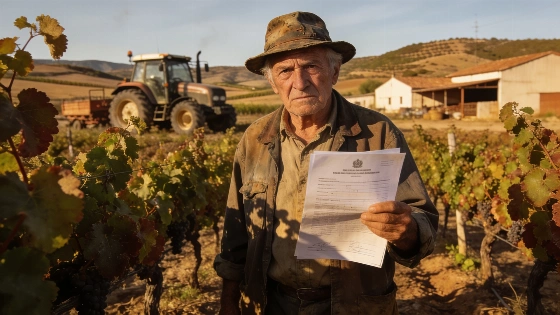
A retired farmer in La Rioja must return nearly €47,000 after authorities found he continued managing his agricultural business while receiving a full pension. The court's decision highlights the strict incompatibility rules between retirement benefits and ongoing self-employment in Spain's farming sector.
When a retired farmer in La Rioja was told to repay €46,837.14 to Social Security, it was the result of a detailed investigation into his post-retirement activities. Despite officially retiring in 2014, the man remained the owner and apparent manager of his agricultural business, even as his wife was listed as the active worker in the system. The Tribunal Superior de Justicia de La Rioja has now confirmed that these actions breached Spain’s pension rules, supporting the Social Security Institute’s demand for reimbursement.
According to the court documents, the farmer’s name continued to appear on key assets: he owned the land, the tractor was registered to him, and he held the license required for handling agricultural chemicals. While his wife was formally registered in the Special System for Self-Employed Agricultural Workers, labor inspectors found no convincing evidence that she was actually running the farm. This led authorities to conclude that the retiree was still actively engaged in the business, making his pension incompatible with his ongoing work.
As a result, Social Security retroactively registered the farmer as an active agricultural worker from April 2020. From that date until November 2022, all pension payments he received were deemed improper, triggering the demand for repayment. The court’s decision also included a temporary suspension of his pension rights for the period in question.
The farmer argued that his income did not exceed the legal threshold for combining pension and work, claiming that his net earnings, calculated under Spain’s agricultural tax modules, should allow for an exception. However, both the lower court and the regional high court rejected this interpretation. They found that the nature of his involvement required full registration and contributions to the agricultural system, making the pension and the work fundamentally incompatible.
Judges also noted that the couple appeared to split farm income between them to stay under the legal limits, a practice the court saw as an attempt to mask the true scale of the retiree’s activity. This manipulation was a key factor in confirming the incompatibility and upholding the Social Security’s claim.
The legal basis for the ruling rests on Article 213 of the General Social Security Law, which generally prohibits drawing a full retirement pension while engaging in any work, except for narrowly defined exceptions. Additional articles specific to the agricultural sector reinforce the obligation to contribute and the incompatibility of simultaneous pension collection and active farm management.
This case underscores the strict enforcement of pension rules in Spain, particularly for self-employed workers in agriculture. It also highlights the importance of clear documentation and genuine role separation for families involved in farming businesses. For those interested in how Spanish law addresses the rights and obligations of seniors in other community roles, there are legal provisions allowing homeowners over 70 to step down from mandatory association duties, as detailed in this related analysis of legal relief for elderly community presidents.
With the court’s decision now final, the farmer faces the financial consequences of breaching the rules—a reminder that, in Spain, retirement and ongoing business activity rarely mix without careful legal compliance.