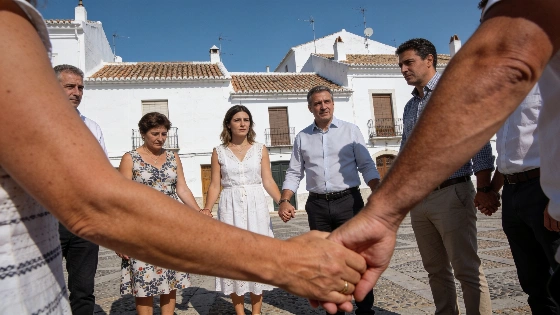
Over 20 Spanish municipalities led by PSOE and IU are holding their own rallies for Ceuta. They reject the PP and FEMP’s protest, citing lack of consensus. The move highlights deepening political divisions over support for the autonomous city.
More than twenty municipalities governed by PSOE and IU have announced alternative rallies in support of Ceuta, distancing themselves from the protest called by the Federación Española de Municipios y Provincias (FEMP) and the Partido Popular (PP). The FEMP’s demonstration, set for Wednesday evening, has drawn criticism from other political groups for being organized without consensus, intensifying the political split over how to express solidarity with Ceuta.
In Andalusia alone, at least 14 towns—including Espartinas, Los Palacios, Moguer, Bonares, Santa Olalla del Cala, Armilla, Íllora, Cúllar Vega, Salar, Chiclana, Grazalema, Trebujena, Úbeda, and Adamuz—will hold their own events. Similar initiatives have emerged in Castilla y León, the Comunidad Valenciana, and Extremadura. Many of these municipalities have deliberately scheduled their rallies at different times or on different days from the FEMP’s protest to avoid overlap and to signal their disagreement with the approach taken by the PP and FEMP leadership.
Local leaders argue that the FEMP’s call was not coordinated with all parties and risks turning a show of support for Ceuta into a political confrontation. In Espartinas, the socialist mayor Cristina Los Arcos scheduled a midday event on Ceuta Day, emphasizing that the gathering is solely to recognize the people of Ceuta, without political slogans or objectives. The event was promoted on social media by Los Arcos and Gema Gamir, the local councillor for Social Policies and a native of Ceuta, who encouraged residents to participate. Organizers stress that their actions are not an act of defiance against the PSOE’s Andalusian leadership, which has advised against joining events seen as politically instrumentalized by the PP.
Other mayors echo this stance. Loli Cañavate, the socialist mayor of Armilla, underlined that their rally is focused on solidarity, not party politics. In Moguer, mayor Gustavo Cuéllar stated that he received no restrictions from the party leadership and framed the demonstration as part of a tradition of supporting freedom of expression and assembly. He also highlighted the need for greater cooperation between administrations to address challenges linked to migration, noting that Moguer’s population swells during agricultural seasons, straining local services.
In Grazalema, mayor Carlos Javier García used social media to clarify that their participation is meant to reject ongoing political confrontation and to offer support to Ceuta, not to serve as a political tool. Adamuz’s mayor Rafael Moreno described their midday rally as institutional and strictly supportive of Ceuta, distancing it from any political connotations. Úbeda’s PSOE-led council will host a manifesto reading at La Central, aiming for an open, non-partisan event for citizens to express support for Ceuta.
IU-led municipalities have also scheduled separate rallies, with Los Palacios y Villafranca’s mayor Juanma Valle calling for a unified response from all public administrations to the Ceuta crisis. IU’s federal coordinator Antonio Maíllo, along with PSOE-A’s secretary general María Jesús Montero and Adelante Andalucía’s José Ignacio García, confirmed they will not attend the flag-raising for Ceuta in the Andalusian Parliament, viewing it as a unilateral and politically charged event organized by the PP.
Alternative rallies are planned in other regions as well. In León, mayor José Antonio Díez (PSOE) will join a civil society-led event for Ceuta. In the Comunidad Valenciana, Sagunto’s council will hold a midday rally with a manifesto and a minute of silence for those who died on July 30. Gandía’s council has also called an institutional rally, with Vox absent from the planning meeting. In Extremadura, Mérida’s socialist government will host a “Mérida con Ceuta” rally in Plaza de España, while Almendralejo’s council emphasized that supporting Ceuta should not become a source of political division.
This wave of alternative rallies reflects a broader trend of local governments seeking to express solidarity with Ceuta while resisting what they see as the politicization of the issue by national parties. The debate over how to support Ceuta has exposed deep divisions within Spain’s political landscape, echoing previous moments of tension over migration and border policy. As noted in a related report, Ceuta’s calls for nationwide support have repeatedly highlighted the challenges of forging unity across party lines during times of crisis. The current standoff underscores the complexities of balancing institutional solidarity with political interests, especially as migration and border issues remain at the forefront of Spain’s national debate.
Ceuta, a Spanish autonomous city on the North African coast, has long been a focal point for migration and border security concerns. The city’s unique position has made it a symbol of both Spain’s territorial integrity and the broader challenges facing the country’s migration policy. The recent surge in political activity around Ceuta reflects not only immediate events but also ongoing debates about how best to manage solidarity, security, and cooperation among Spain’s diverse regions and political actors.