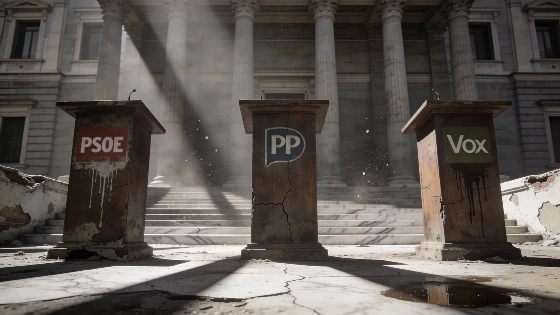
The latest +Democracia ranking shows PSOE's score falling sharply after recent scandals. PP remains stagnant, while Vox fails in all categories. The report highlights persistent weaknesses in party democracy.
Spain's main political parties have received a harsh assessment in the latest democracy quality ranking by +Democracia, with PSOE's score dropping significantly following a series of corruption scandals. The report, led by political scientist Cristina Monge, points to ongoing failures in internal democratic practices and a lack of progress on anti-corruption measures, despite repeated recommendations in previous years.
According to the fifth edition of the ranking, the average score among the 17 parties analyzed stands at 5.7. Ten parties, including Compromís, Comunes, ERC, EH Bildu, Podemos, Izquierda Unida, PNV, PSC, CHA, and Junts, scored above this average. In contrast, six parties—Coalición Canaria, BNG, Más Madrid, PSOE, PP, and Vox—fell below. Vox received the lowest score at 1.7, followed by PP at 2.9 and PSOE at 3.6, a sharp decline from its previous 5.4. Compromís, Comunes, and ERC lead the ranking with scores of 8.3, 8.2, and 7.7, respectively.
The evaluation is based on six categories: internal organization, member rights and protections, territorial autonomy, transparency, ethical codes and accountability, and the system for selecting public officials. The report notes that many parties fail to follow their own rules, undermining internal democracy. It also highlights that, according to CIS surveys, the functioning of political parties is an increasing source of public concern, ranking just behind housing and economic issues. The Eurobarometer further indicates declining public trust in political parties in Spain, with figures well below the EU average.
PSOE's performance has deteriorated across several areas. The party now scores 3.1 for internal organization, 2.3 for member rights, 6 for territorial autonomy, 6.4 for transparency, 4.3 for ethical codes, and just 2.3 for the selection of public and organizational positions. The report criticizes recent changes at the PSOE federal congress, which raised the threshold for primary candidacies, making it harder for alternative voices to compete and consolidating the power of the party leadership. It also points to rushed processes and the central leadership's influence over candidate selection, which have further weakened internal democracy.
On member rights, the report highlights a gap between formal protections and actual practice, especially in handling sexual harassment complaints. The case of Francisco Salazar, a close aide to Prime Minister Pedro Sánchez who resigned after harassment allegations surfaced, is cited as an example. Months after the allegations, the party had not contacted the complainants, prompting public criticism from PSOE's own equality officials and a public apology from Sánchez.
PSOE's score for ethical codes has dropped by three points since the last report, with recent scandals involving former Organization Secretaries Santos Cerdán and José Luis Ábalos—who was recently sentenced to 24 years in prison in the 'mascarillas' case—damaging the party's credibility. The report argues these incidents show a failure to enforce ethical standards and respond effectively to violations.
PP also fares poorly, failing in five out of six categories. Its lowest score is in transparency (1.3), the worst among all parties analyzed. The only area where PP passes is member rights (5.7). The report notes that, despite formal territorial autonomy, the national leadership imposed negotiation frameworks during government formation with Vox in several regions, leading to a two-point drop in this category. The study also points to PP's use of 'tránsfugas' (party defectors) to secure majorities in local governments, in violation of its own statutes and anti-defection agreements. Additionally, the report highlights the lack of effective channels for reporting harassment, referencing cases where complaints were ignored or suppressed, such as the incident in Móstoles revealed by El País.
Vox receives failing marks in all six categories, with the lowest scores for internal organization and territorial autonomy. The report describes a period of internal turmoil, including expulsions from the leadership, the elimination of primary elections, and ongoing investigations into funding sources and the role of party foundations. According to the analysis, Vox has reinforced a highly centralized structure with little internal democracy.
For context, Spain has seen repeated calls for stronger party transparency and anti-corruption measures over the past decade, but key reforms—such as lobby regulation—remain stalled in parliament. Public trust in political parties continues to erode, as reflected in both national and European surveys. The +Democracia ranking is one of the few systematic efforts to track and compare the internal democratic standards of Spanish parties, providing a reference point for ongoing debates about political accountability and reform.