Two PSOE employees told the National Court that Santos Cerdán authorized travel expenses and parking access for Leire Díez. Their testimony intensifies the investigation into alleged interference in judicial cases linked to the party.
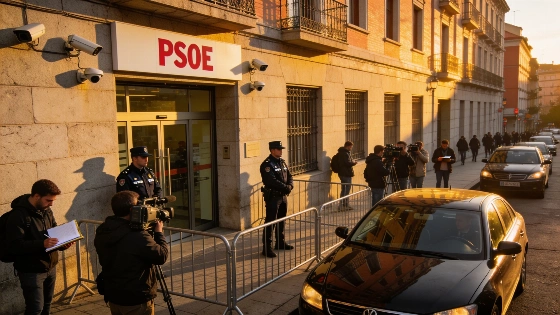
Two employees of the PSOE have placed former Organization Secretary Santos Cerdán at the center of a judicial investigation, stating before the National Court that he personally authorized both travel expenses and parking access at the party’s Ferraz headquarters for ex-member Leire Díez. This testimony, delivered by Celia R. and Covadonga S. P., comes as part of a broader probe into alleged attempts to obstruct judicial proceedings involving figures close to the government and the PSOE.
During their appearance, both employees agreed to allow the Guardia Civil to clone the contents of their mobile phones, as requested by Judge Santiago Pedraz. Investigators believe that communications from April 2024 to June 2025 between the secretaries and key figures—including Cerdán, Díez, party manager Ana María Fuentes, and former Correos president Juan Manuel Serrano—could clarify who issued critical instructions within the alleged scheme.
Although Celia R. and Covadonga S. P. were initially under investigation, the judge later lifted their status as suspects, acknowledging there was no evidence they knowingly participated in illicit activities. Now testifying as witnesses, they described how Cerdán’s authorizations for Díez were exceptional, as such arrangements were typically reserved for executive members. Once Cerdán approved, Díez would contact the secretaries directly via WhatsApp to coordinate her parking access. The employees noted that while Díez frequently used the garage, she often did not enter the party headquarters itself, usually just leaving her car.
Contradicting the Central Operative Unit (UCO) of the Guardia Civil, which reported 18 meetings between Díez and Cerdán, the secretaries recalled only three or four such gatherings at the Ferraz headquarters. These meetings, they said, also included Juan Manuel Serrano and businessman Javier Pérez Dolset, both of whom are implicated in the case. Notably, these meetings were not recorded in Cerdán’s official agenda.
Regarding travel expenses, the employees confirmed that the PSOE paid for Díez’s tickets, with Cerdán instructing them to arrange bookings through the party’s usual travel agency. They emphasized that Cerdán never explained the purpose of these trips, nor did they inquire. The secretaries also distanced themselves from payments made to lawyers Jacobo Teijelo and Ismael Oliver, stating they had no involvement in handling contracts or invoices. As for Ana María Fuentes, the party’s manager and another suspect, the employees clarified that she never issued them instructions regarding legal contracts.
This case adds to a series of internal challenges for the PSOE, which has recently faced leadership disputes and primary contests, such as the one involving Enma López in Madrid. For context, the party’s internal dynamics were highlighted when Enma López challenged the party leadership in the Madrid mayoral primaries, underscoring ongoing tensions within the organization.
The investigation into Cerdán and Díez is part of a wider judicial effort to clarify whether party resources were misused to influence legal proceedings. The willingness of the secretaries to cooperate by providing their communications may prove pivotal in determining the extent of internal knowledge and responsibility. The case also illustrates the scrutiny facing Spain’s major political parties regarding transparency and internal controls, especially when exceptional authorizations and financial decisions are involved. As the probe continues, further revelations could impact both the party’s public image and its internal governance practices.