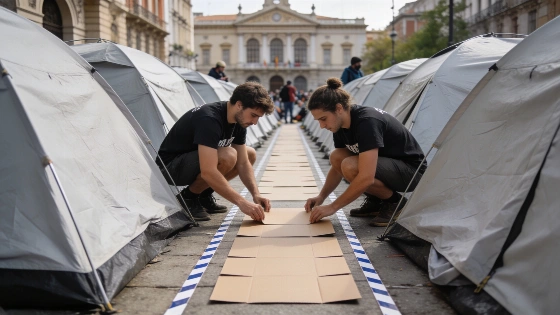
A morning count on September 30 put the Puerta del Sol housing camp at 1,248 tents. Two volunteers are mapping the square, naming its routes and dividing it into political sectors.
By the morning count on September 30, Puerta del Sol held 1,248 tents. Alejandro T. and Quico C. are trying to make movement possible through the crowded square. They draw routes, mark sectors and give names to the spaces occupied by protesters. The Guardian and RTÉ described the camp as a fast-growing response to Spain's housing crisis.
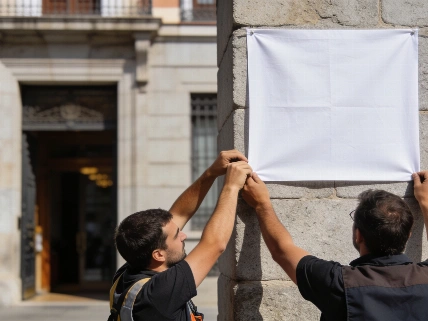
The signs do real work. "Avenida Maricarmen" marks the main vertical route from the Real Casa de Correos. Other cardboard labels name "La Guillotina", "Calle de la Rabia", "Tercera República", "Plaza La Veneno" and "Miguel Hernández". The names give the camp a shared map as access between hundreds of tents becomes harder.
The map is practical and political.
The mobilisation was triggered in part by the eviction case of Maricarmen, an 87-year-old woman, but organisers connected it to the broader housing crisis and demands for stronger protection for tenants.
Two days before the map took shape, an assembly agreed to create internal access routes. Different sectors needed a way to communicate. Quico received pieces of cardboard and began handing out labels among the tents. Alejandro keeps the changing layout in a notebook. He adds new tents as they appear at the edges of the square.
The structure is simple.
A vertical route divides the plaza into two main areas. The design borrows from the ancient Roman cardo and decumanus, two crossing roads used to organise cities. The camp's main axes are Avenida Maricarmen and the street named after 26 September, the day the occupation began. Democrata compared the developing layout with a city that has its own streets and map.
The camp has not been presented by its organisers as a short-lived installation. Alicia del Río of the tenants’ union said there was no fixed end date and that forms of civil disobedience would continue while participants awaited and examined the government’s housing measures.
People run each section. Their spokespersons coordinate through messaging channels and pass decisions to nearby tents. Adhesive tape marks some corridors. Cardboard notices show entrances, exits and the names of particular areas. Some protesters picked their own street names. Others used signs prepared by the organisers.
According to Somos Madrid, the map shows the political character of the protest as much as its practical needs. Alejandro and Quico are considering more names for central routes and areas with heavy activity. The spaces called plazas work as social meeting points. Their notebook mentions Rosa Luxemburgo, Pedro Zerolo and Nati Camacho. It also lists Plaza Lésbica, Plaza de Gaza and Lucha de clases, along with areas linked to political parties.
The housing dispute brought people to Sol. The Saturday mobilisation followed anger over Maricarmen's eviction and a joint demand for a decree. That demand has since been split in two, and the decree is not expected to pass. Euronews and The Guardian reported that the action grew out of a mass housing demonstration. Protesters wanted structural changes, not only a solution to one eviction case. The wider political fight was already visible in an earlier housing report.
The comparison with the 15M occupation of Puerta del Sol in 2011 is hard to avoid. Alejandro and Quico see a wider mix of groups this time. Their sketch includes Plaza de las Queeras near the Cercanías access known as the whale. Housing unions are in the camp too. So is a yellow-clad group of early-years educators seeking improvements in Madrid's 0-to-3 education system.
For many participants, the pressure is personal. Property portals list housing in the area at around 7,000 euros per square metre. Ana, a Madrid student in her early twenties, says her older sister has spent months unable to leave the family home. Three friends named their tent Plaza Matterhorn after their scout group.
Days are busy.
People read on beach chairs, share meals and move sleeping bags, food and basic supplies through the camp. The mood can be calm. The demand is still political. At Tuesday night's assembly, the Sindicato de Inquilinas said speculation should no longer be treated as normal. It should bring shame, the union said. Participants kept the camp in place as they waited for the government's housing decree and reviewed its details, according to Spanish media reports.
The growing camp has sharpened the fight around the square. Madrid's regional and city authorities, including Isabel Díaz Ayuso and José Luis Martínez-Almeida, demanded its evacuation. They called it unlawful and said it disrupted residents, tourists and businesses. The central government delegation took a more cautious position. It said it would maintain public safety and protect the Real Casa de Correos. It also recalled the right to peaceful assembly.
The dispute then became more dangerous. Far-right figures called for the protesters to be forcibly removed. Supporters of the camp called for protection against attacks.
Alejandro and Quico have not built a finished civic system. The notebook does not erase the disorder of 1,248 tents in a central square. It does give people shared routes and a way to stay connected. The map turns the occupation into an organised space. Its political names show that the camp is not using Puerta del Sol only as a backdrop. Protesters are claiming the square as a temporary public space shaped by the housing struggle.