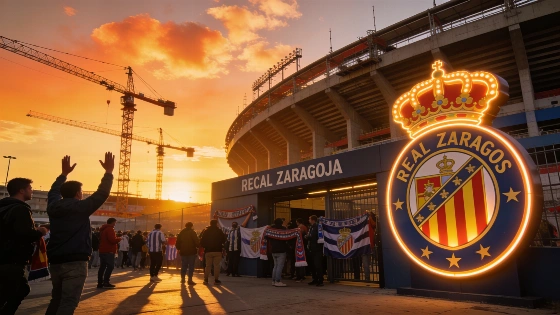
Real Zaragoza’s new leadership has outlined a sweeping plan to rebuild the club’s identity and set a course for long-term success. Described as a multi-decade commitment, the project aims to reconnect the team with its roots while addressing the challenges of competing at its current level. Management says every available resource from A.GAIN and the club will go toward the effort, combining international investment capacity with a locally rooted vision for the institution.
The proposed change in ownership provides the financial and governance context for that plan. A.GAIN agreed to acquire the 75% stake held by Real Z LLC and participate in a capital increase exceeding €22 million, including an €8 million contribution. The operation was expected to give A.GAIN approximately 60% of the club, with share capital rising from €49.015 million to more than €71 million. The group led by Jorge Mas and Juan Forcén was expected to retain about 39.3%, while minority shareholders would hold the remaining shares, information from reporting by El Periódico de Aragón.
The transaction still required authorization from Spain’s Consejo Superior de Deportes (CSD). The formal application was reportedly submitted in early October 2026 after bureaucratic delays, with an extension agreed on 15 September. Wider governance changes were expected after CSD approval and a shareholders’ meeting scheduled for December. The distinction matters: the commercial agreement does not itself complete the legally effective transfer of control. The incoming leadership structure puts Guido Baroli, appointed the club’s general director, and A.GAIN managing partner Santos Nagore at the center of day-to-day management. The planned board was expected to include A.GAIN chief executive Bobby Aitkenhead and figures connected with Zaragoza and its supporters.
In its initial assessment, the new team said it was satisfied with the club’s professional staff and existing resources. It identified clear decision-making and accountability as priorities, pointing to a more process-driven approach. Baroli’s stated emphasis on “Aragonese roots and identity,” as summarized by Sport Aragón, reflects the effort to pair the group’s investment capacity with a stronger local connection. The leadership has also acknowledged the expectations attached to Real Zaragoza’s history and the scale of the work ahead.
One immediate step is a meeting with Lalo, the newly appointed president, to define the sporting direction. The club’s approach to transfers will center on efficiency and a careful budget review, with financial discipline guiding decisions. A.GAIN’s wider investment platform provides context: IDC Network announced a $150 million sports-and-entertainment fund in April 2026, with a strategy covering clubs and related businesses and assets. EFE, in reporting published by Libertad Digital, described A.GAIN as the group’s vehicle focused on technology and sport, with entertainment also in its remit. The Zaragoza project is part of a wider investment strategy, although its implementation remains tied to the regulatory and corporate timetable.
The season-ticket campaign is set to launch after delays linked to the ownership transition, while the club is also preparing to reveal its new kit. The leadership is asking supporters for patience as it works to rebuild trust through results and transparent management. Real Zaragoza’s stadium arrangements also affect its finances: reporting in March 2026 described an €8 million payment to the club linked to naming rights. A related agreement was reported to total €10 million over ten years, including €2 million for 2025 and 2026 associated with Ibercaja Estadio and €8 million from 2027 connected to the future Ibercaja Romareda.
The future stadium lease also has implications for the club’s long-term costs. Socialist councillor Horacio Royo said, after reviewing the contract, that Real Zaragoza would not pay the lease until construction was complete and the stadium formally handed over. Reporting on the agreement said maintenance responsibilities would begin on 1 January 2031, after the 2030 World Cup. The stadium project is financed predominantly with public money, according to the same coverage, while the club is expected ultimately to operate the venue. These terms are part of the financial structure the incoming management will need to account for.
Investment in the Ciudad Deportiva, the club’s training complex and youth-development base, is basic to the strategy. Management sees the academy as a critical “factory” for future talent and recognizes the need for sustained investment. The complex also carries institutional significance: on 21 October 2026, Real Zaragoza announced that Campo 1 would be renamed Campo Jorge Casado Roche in tribute to the late club figure, with commemorative activities planned. The announcement highlights the training ground’s place in the club’s heritage and sporting future.
Across Spanish football, Real Zaragoza’s rebuilding effort reflects the challenge historic clubs face in balancing tradition with modern demands. The club’s focus on identity and youth development comes as teams reassess their structures and community ties, with local leadership part of that effort. Recent events in Spanish media, including the on-air confrontation that led to a presenter’s emotional exit on 'Malas lenguas noche', have highlighted the pressures and expectations surrounding public figures and institutions. For more on how high-profile departures can affect organizations, see the coverage of the incident involving Marta Gómez Montero at this recent broadcast clash.
Founded in 1932, Real Zaragoza has a storied history in Spanish football, including multiple Copa del Rey victories and a UEFA Cup Winners’ Cup title. The club has also faced impressive challenges in recent years, including relegation and financial instability. Its new project centers on identity and youth development, under transparent management, while the proposed ownership change and stadium arrangements will shape the resources and obligations available to the club. The coming months will be critical as Real Zaragoza seeks to turn its stated ambitions into progress on and off the pitch.