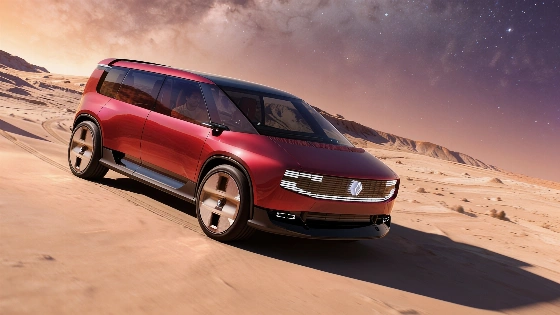
Renault has not committed the E-Space Concept to production. But the prototype could preview an electric successor to the Espace built in Palencia, part of a wider plan for five new models at Spanish plants by 2028.
Renault’s press materials describe the E-Space as an exploration of future electric family cars. They also make clear that a production version is not currently planned. The concept could preview a successor to the Espace now made in Palencia, and it may become one of two electric models planned for the plant. Renault has not confirmed that assignment.
The proposal goes beyond a change in powertrain. Renault frames it as a reimagining of the MPV, guided by its «voitures à vivre» philosophy. The company says the design prioritises interior space and flexibility, with large glazed areas and new exterior lighting that extends to the front grille.
The Espace nameplate dates back to 1984. Renault presents E-Space as an electric continuation of that model line, while emphasising that this project remains a concept rather than a planned production car.
The concept is designed to seat up to six people, with a screen for each occupant. That points to a cabin where space and technology remain central as Renault considers electric power. The company scheduled the E-Space Concept’s world premiere for 12 October 2026 at the Paris Motor Show, as one of three brand concepts. Renault confirmed the vehicle is more than 4.70 metres long, but had not disclosed its range, power or battery capacity ahead of the premiere.
The industrial plan gives the concept a possible route to production. At the end of May, Renault confirmed it intends to build five new models at its Valladolid and Palencia plants by 2028: three hybrids and two electric cars. Renault Group has also announced a €600 million investment programme for Spain through 2030. It covers five new models across the company’s Spanish plants, including two fully electric vehicles. A battery-assembly line is also planned for Valladolid. Renault has not said which vehicles will fill every production slot.
Palencia could receive a hybrid model that may succeed the Austral. A fully electric Rafale is another possibility for the plant. Both electric models are expected to use the group’s RGEV 2.0 platform. Renault’s industrial plan identifies the Palencia plant’s technology as RGEV Medium 2.0, which would let it build two medium-sized electric vehicles. Valladolid, now home to the Renault Captur and Symbioz, is due to receive two new hybrid models.
Renault Group’s announced Spanish investment programme totals €600 million through 2030. It includes a battery-assembly line in Valladolid, alongside plans for five new models across its Spanish plants.
A recent Geely feature linked an electric car to Shakira’s concerts. Renault’s Paris concept instead has a potential connection to a stated plan for Spanish factories.
A prototype can show a possible direction without securing a production slot. Renault has not announced a production timetable or confirmed that the E-Space will enter series production.