Rototom Sunsplash in Benicàssim launches its summer edition with reinforced climate adaptation, saving over three million plastic bottles. Organizers focus on sustainability, heat protection, and social debates.
Rototom Sunsplash opened its doors this week in Benicàssim, marking the final major festival of the Valencian summer with a clear shift toward environmental responsibility. Organizers have confirmed that, through a partnership with Tuawa, the event has prevented the use of 3.2 million plastic bottles since 2021. This achievement, highlighted at the start of the festival, means the equivalent of 13,500 trees would have been needed to absorb the CO2 from producing, transporting, and recycling those bottles.
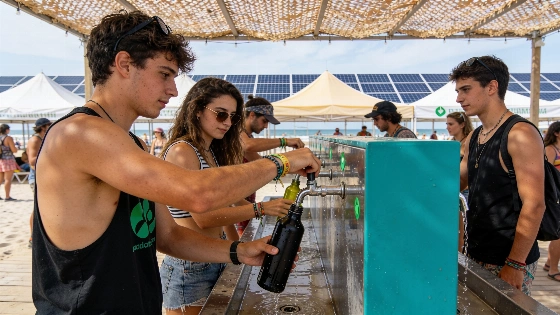
To further reduce its environmental impact, Rototom has installed 54 water fountains across the festival and camping areas, aiming to replace the traditional bottled water sales model. The festival’s commitment to sustainability is also visible in its infrastructure: shaded, ventilated spaces like Pachamama, Jamkunda, and Magicomundo now serve as climate refuges, offering relief from high temperatures and hosting cultural activities away from the main stages. This year, Pachamama debuts a hexagonal flower-shaped structure, while Jamkunda’s area is protected by a UV-resistant lycra canopy.
In response to rising summer heat, the festival has shifted concert area opening times to 5 p.m. and scheduled high-attendance activities for sunset. These changes are part of a broader adaptation strategy that includes LED lighting, solar-powered camping zones, large-scale recycling, water reuse, and a focus on local food products. The festival’s “greensplash” philosophy is reinforced by a new hybrid energy system, developed with GTECH, which is expected to save around 3,000 liters of fuel and prevent 7.7 tons of CO2 emissions during the event week.
Rototom Sunsplash positions itself as more than a music festival, integrating debates on urgent social issues such as climate emergency, housing crisis, racism, human rights, and ecofeminism. The Social Forum returns this year with sessions on housing rights and the intersection of culture, music, and wellbeing, featuring speakers like Harvard neurologist Álvaro Pascual-Leone and humanitarian psychologist Betty Roca Hubbauer. The climate crisis will be addressed in a dedicated session with Indian ecofeminist Vandana Shiva and Colombian activist Francisco Vera, emphasizing the global and social justice dimensions of environmental challenges.
Attendance is expected to reach 25,000 visitors per day, with a lineup that blends reggae roots and global urban sounds, including Major Lazer Soundsystem, Protoje, Shenseea, Alpha Blondy, Luciano, Skatalites with Alpheus, Greentea Peng, Dub Inc, and Spanish acts like Kiko Veneno and Lia Kali. The festival’s approach to sustainability and adaptation stands out in a season where large events face increasing scrutiny over their environmental footprint. This focus on practical solutions echoes broader trends in Spain, where environmental activism and local initiatives—such as those described in reports on long-term ecological efforts in Mijas—are shaping the future of public events and community life.
Rototom Sunsplash’s ongoing efforts reflect a wider movement among European festivals to address climate risks and resource consumption. The festival’s plastic-free policy, energy innovations, and social programming illustrate how cultural events can serve as testing grounds for sustainable practices. As Spain continues to experience hotter summers and environmental pressures, such initiatives may become a model for other large gatherings seeking to balance entertainment with ecological responsibility.