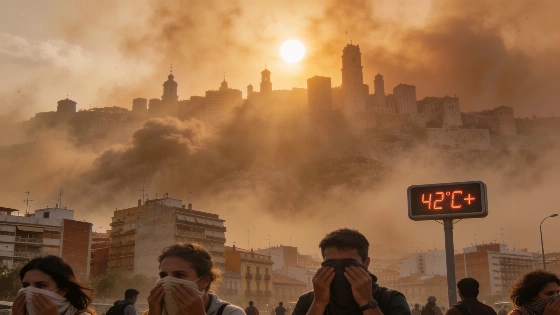
A new heatwave is sweeping into southern and eastern Spain, bringing temperatures above 42°C and a dense Saharan dust cloud. Authorities urge caution as the combination of heat and calima is expected to impact millions, with the worst conditions forecast for Andalucía, Extremadura, Murcia, Castilla-La Mancha, and southern Valencia.
Temperatures are set to surge past 42°C this week as a powerful heatwave, accompanied by a thick Saharan dust cloud, spreads across southern and eastern Spain. The State Meteorological Agency (AEMET) has issued warnings for Andalucía, Extremadura, Región de Murcia, Castilla-La Mancha, and the southern part of the Valencian Community, where the effects of the calima will be most pronounced.
The intrusion of Saharan dust began entering the Iberian Peninsula from the south on Tuesday, July 28, 2026, and is now advancing northward. By Wednesday, the haze is expected to blanket large areas, reducing visibility and giving the sky a milky or ochre hue. According to AEMET, this episode is likely to persist through at least Sunday, August 2, with a high probability of continued extreme conditions.
Heat and Dust Intensify
This weather pattern is driven by a subtropical ridge over the peninsula and southerly winds, which are channeling hot air and mineral particles from North Africa. As a result, the interior of Spain will experience both stifling heat and a persistent veil of dust, making outdoor conditions challenging and potentially hazardous.
Between Wednesday and Friday, the calima will be nearly constant in the most affected regions. While dust concentrations are not expected to reach record levels, they will be sufficient to dull the sky and create a heavy atmosphere, especially during peak afternoon hours. In some southwestern and inland areas, the Saharan dust may mix with smoke from ongoing wildfires, further thickening the haze and compounding health risks for those working outdoors.
Calima Spreads North and East
The dust cloud is forecast to move gradually toward Madrid, Castilla y León, Aragón, Navarra, La Rioja, much of eastern Spain, and the Balearic Islands. In the Valencian Community and the Ebro Valley, skies may remain pale and hazy for much of the week, coinciding with the hottest period. The Canary Islands are also expected to be affected, with a significant influx of calima and rising temperatures from Thursday, July 30. The most intense heat will strike the mid-altitude and interior zones of the larger islands, where the haze could linger for several days.
Record Temperatures Expected
On Wednesday, maximum temperatures are forecast to reach 39–41°C in the main valleys of the southwest, 37–39°C in parts of the northern plateau and La Mancha, and 40–42°C in the Ebro Valley and northeastern depressions. Localized peaks above 42°C are possible, particularly during the weekend, when the southern interior may also see sustained highs between 40 and 42°C. Nights will remain uncomfortably warm, especially in humid areas, making restful sleep difficult and increasing the risk for vulnerable groups.
Authorities recommend paying close attention to official advisories, especially for those working outdoors or with health conditions. In some cases, workers may be entitled to special leave during periods of extreme heat, as outlined in recent labor guidelines.
Storms Could Bring Mud Rain
As the weekend approaches, a trough is expected to increase atmospheric instability, particularly in the northeastern corner of the peninsula. Thunderstorms in Catalonia and the Pyrenees may coincide with lingering dust in the atmosphere. When rain falls through a dust-laden sky, it can result in muddy precipitation, leaving visible deposits on surfaces. However, the occurrence of this phenomenon will depend on the overlap of rain and dust in both time and place, and forecasts remain subject to change.
AEMET advises the public to monitor its special heatwave bulletins for the latest updates and safety recommendations.
For context, episodes of Saharan dust and extreme heat have become more frequent in recent years, often leading to increased health risks, reduced air quality, and disruptions to daily life. Residents are encouraged to take precautions, stay hydrated, and limit outdoor activity during the hottest hours.