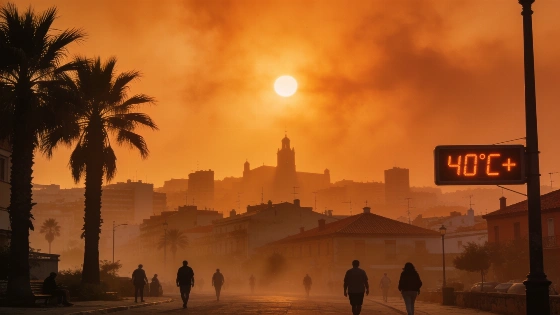
A mass of Saharan air is bringing dust and extreme heat to southern and eastern Spain. Visibility is dropping and the air feels heavier. Authorities warn of persistent haze and temperatures above 40°C in several regions.
Southern and eastern Spain are facing a double weather threat this week as a dense cloud of Saharan dust combines with the fourth major heatwave of the summer. From early Tuesday, a warm air mass from North Africa began pushing into the peninsula, driving up temperatures and filling the skies with suspended particles. The result: reduced visibility, a persistent haze, and a stifling sense of humidity across key regions.
Andalusia, Extremadura, the Region of Murcia, southern parts of the Valencian Community, and Castilla-La Mancha are experiencing the most intense effects. The dust, carried by southerly winds, is expected to linger for several days, with the haze spreading northward as the week progresses. By Wednesday, the phenomenon will reach Madrid, Castilla y León, Aragón, Navarra, La Rioja, and the Balearic Islands, turning skies milky and further diminishing air clarity.
Forecasts indicate that the haze will be nearly continuous in the south and east through Friday. While dust concentrations are not expected to reach record highs, they are sufficient to noticeably cloud the atmosphere, especially during midday hours. The situation is compounded by smoke from ongoing wildfires, particularly in the southwest and interior, where skies are already veiled by fine particles. The arrival of Saharan dust is intensifying this effect, creating a heavy, almost oppressive environment. In many areas, daytime temperatures are set to exceed 40°C, with some locations in the Guadalquivir valley, Extremadura, and southern Castilla-La Mancha potentially surpassing 42°C.
As the dust cloud advances, the combination of extreme heat, suspended particles, and, in some sectors, higher humidity is making the air feel even more suffocating. The impact is not limited to the south: by midweek, the haze will reach the Ebro valley and much of eastern Spain, with the Valencian Community and Ebro valley expected to see the most pronounced effects. The Canary Islands are also forecast to experience significant dust intrusion from Thursday onward.
Nighttime relief will be scarce, as minimum temperatures in the interior north and east are forecast to remain high, complicating sleep and daily routines. In the Ebro valley, maximums could reach or exceed 40°C, while much of the interior will see highs between 35°C and 38°C. Toward the weekend, a trough approaching from the northwest will increase instability in the far northeast, with storms in Catalonia and the Pyrenees likely to interact with lingering dust, raising the risk of muddy rain events.
Episodes of Saharan dust are not new to Spain, but their combination with heatwaves and wildfire smoke is creating particularly challenging conditions this summer. According to recent reports on wildfire evacuations in Ávila, the presence of fine particles in the air can complicate both visibility and respiratory health, especially for vulnerable groups. Authorities recommend limiting outdoor activity during peak hours and keeping windows closed when dust levels are high.
Spain's geography and climate make it especially susceptible to Saharan dust intrusions, particularly during periods of strong southerly winds and high atmospheric pressure. These events can affect air quality, disrupt transportation, and impact agriculture. The current episode underscores the growing challenges posed by extreme weather patterns and the need for ongoing adaptation in affected regions.